









Pottery has a way of calling to people. Maybe it was a video of hands shaping a lump of clay into a perfect bowl in ninety seconds, or a shelf of handmade mugs at a friend’s house that felt warmer than anything from a store. Whatever it was, you are here now, wondering whether you could actually do this at home — and whether an online course can really teach you.
Short answer: yes, with caveats. Online ceramics courses are genuinely excellent at teaching technique, but pottery has physical realities — kilns, clay dust, drying space — that no video can solve for you. This guide is the honest comparison I wish someone had handed me before I bought my first bag of clay: wheel versus hand building, the kiln question answered straight, what it all costs, and how to pick a course that respects your intelligence.
Wheel throwing vs. hand building: an honest comparison
Every pottery journey starts with this fork in the road. Both are real pottery. Both can produce beautiful, functional work. But they ask very different things of you.
| Wheel throwing | Hand building | |
|---|---|---|
| What it is | Shaping clay on a spinning wheel | Building with coils, slabs, and pinching |
| Startup cost | Higher — a wheel alone runs a few hundred dollars | Lower — basic tools and clay get you going |
| Space needed | Dedicated corner; wheels are heavy and splash | A sturdy table you can wipe down |
| Learning curve | Steep at first — centering takes weeks | Gentler — you make recognizable things quickly |
| Best for | Bowls, mugs, vases with symmetry | Sculptural pieces, plates, textured work |
| Online teaching quality | Very good — camera angles show hand positions clearly | Excellent — easy to follow step by step |
| The frustration factor | High early, then deeply satisfying | Low — steady progress from day one |
Here is the honest advice: if videos of the wheel are what drew you in, take a wheel course — but budget for a month of ugly pots first. Centering clay is a body skill, like riding a bike, and it cannot be rushed. If you want finished pieces on your shelf sooner and a calmer start, hand building is the wiser first step. Many potters eventually do both; the hand-building foundation actually makes wheel learning easier, because you already understand how clay behaves.
Whichever path calls to you, the learning principles are the same ones that apply to any creative skill — our field guide to starting a creative skill as an adult is a reassuring companion if you are beginning later in life.
The kiln question, answered straight 🔥
This is the elephant in every home-pottery conversation. Clay needs to be fired in a kiln to become durable, food-safe ceramic. A kiln is hot (over 1,800°F / 1,000°C), heavy, power-hungry, and not something you casually plug in next to the laundry. So what do home potters actually do? There are four realistic answers:
- 1. Air-dry clay (no kiln needed). Perfect for learning hand-building techniques, sculptural pieces, and decorative work. It will not be food-safe or waterproof, but for your first months of practice, that barely matters. Many courses start here deliberately.
- 2. Kiln-sharing services. Search for “kiln firing service near me” — many studios fire other people’s work for a small fee per piece. This is the sweet spot for home potters: you make at home, a professional fires your work.
- 3. Community studios. Membership usually includes kiln access, glazes, and — the underrated bonus — other potters to learn from. If there is one within reasonable distance, it solves the kiln problem and the loneliness problem at once.
- 4. A home kiln (later, maybe). Small electric kilns exist and work well, but they need proper electrical supply, ventilation, and a safe spot (garage, not bedroom). Treat this as a year-two decision, not a starting requirement.
Any course that pretends the kiln is not an issue — or implies you must buy one immediately — is selling you something. The best courses address firing head-on and teach you to plan projects around whatever firing access you actually have.

What home pottery really costs
Costs vary wildly by country, but here is a realistic starter picture so no course can upsell you into panic:
| Item | Hand-building start | Wheel-throwing start |
|---|---|---|
| Clay (a 25 lb / 11 kg bag) | $20–$40 | $20–$40 |
| Basic tool kit | $15–$30 | $15–$30 |
| Wheel | — | $300–$800 (or used) |
| Work surface protection | $10 (canvas, plastic sheets) | $10 |
| Storage (damp box, shelves) | $20–$50 | $20–$50 |
| Kiln firing (per batch, via service) | $10–$40 | $10–$40 |
The used market is your friend: wheels are built like tanks and last decades, so a secondhand wheel from a retiring potter is often the smartest purchase you will make. And before spending anything significant, read when it is worth paying for a course — the same logic applies to equipment.
What to look for in an online ceramics course
Pottery is physical, so the quality bar for online teaching is higher than for, say, a history lecture. Here is what separates the good from the mediocre:
- Camera work that shows the hands. Over-the-shoulder and close-up angles, not a single wide shot from across the room. For wheel work specifically, you need to see hand positions and pressure.
- Mistakes, not just perfection. A teacher who shows what a collapsing wall looks like — and how to save it — teaches more than one who only demonstrates flawless throws.
- A clear skill progression. Cylinder before bowl, bowl before mug with handle, small before large. Courses that jump to impressive projects in lesson two are optimizing for marketing, not learning.
- Troubleshooting content. Cracks, warping, glaze defects, clay that is too wet or too dry — a serious course has a library of “what went wrong” lessons.
- Kiln and firing guidance. Even if you use a firing service, you need to understand bisque vs. glaze firing, cone temperatures, and how to pack work for transport.
- Feedback opportunities. Pottery mistakes are hard to self-diagnose from inside your own hands. Courses with instructor or community critique are worth real money.
A realistic first-year timeline
To calibrate your expectations — because pottery rewards patience more than almost any other craft:
- Months 1–3: You learn clay’s personality. Hand builders finish decorative pieces; wheel students produce a proud collection of wobbly cylinders. Everything is an experiment, and that is exactly right. Setting up a small, dedicated corner helps enormously — see setting up a home study space on a budget for ideas that transfer to a clay corner.
- Months 4–6: Repeatable shapes emerge. Your mugs start to match each other. You develop opinions about clay bodies. Glazing stops being terrifying.
- Months 7–12: You have a style forming — maybe clean and minimal, maybe textured and earthy. Friends start asking to buy pieces. You begin the great debate: hobby or something more?
There will be a week where everything cracks, and a week where the wheel humbles you completely. This is normal. Knowing when to push through versus when to rest is a skill in itself, and pottery will teach it to you.

Five first projects that teach the fundamentals
If your course lets you choose projects, or you are supplementing with your own practice, these five build on each other beautifully:
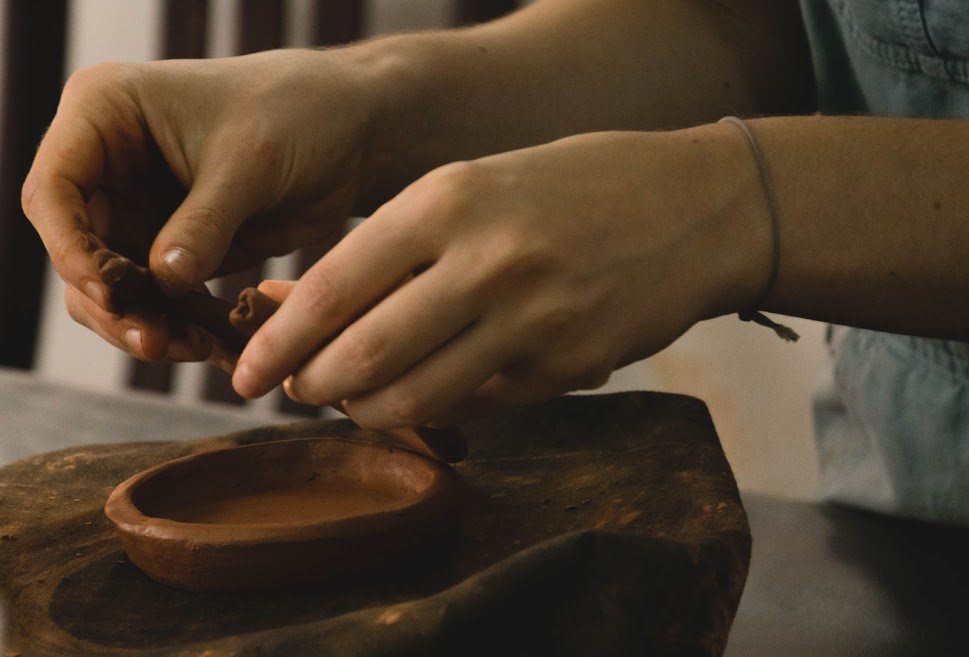
- A pinch pot. The oldest ceramic form on earth. Teaches you how clay feels at the right moisture and how walls thin evenly.
- A coil vase. Coils teach joining — scoring, slipping, blending seams — the skill behind every hand-built piece that survives the kiln.
- A slab box with a lid. Introduces measuring, cutting clean slabs, and the patience of letting pieces firm up before assembly.
- A set of three matching cups. Whether wheel-thrown or hand-built, making a matching set teaches consistency — the true mark of a developing potter.
- One glazed showpiece. Take your favorite bisque-fired piece and glaze it carefully. The reveal after the glaze firing never gets old.
Work through these in order and you will have touched every core skill: forming, joining, drying, and glazing. That is a genuine foundation, not a random pile of crafts.
Glazing: the second craft hiding inside the first
Beginners think pottery is shaping clay. Experienced potters know that glazing — the glass-like coating that makes pieces food-safe and beautiful — is practically a separate discipline. Good courses treat it that way, with dedicated modules on:
- How to apply glaze evenly (dipping, pouring, brushing — each with its place)
- What happens in the kiln at different temperatures
- Testing new glazes on small tiles before committing a favorite piece
- Food safety: which glazes are dinnerware-safe and why it matters
If a course promises “pottery” but never mentions glaze chemistry basics, budget for a second course later — or pick a more complete one now.
The bottom line 🏺
Pottery at home is absolutely doable, and online courses are a genuinely good way to learn it — as long as you go in with eyes open about the kiln, the costs, and the timeline. Start with hand building or air-dry clay if you want quick wins; commit to the wheel if the spinning clay is what you dream about. Solve firing with a local service or studio rather than a panic purchase. And choose a course taught by someone whose hands you trust — because in pottery, the hands are the whole lesson.
The first time you drink morning coffee from a mug you made yourself, slightly lopsided and glazed in a color you mixed — you will understand why people never really quit this craft. They just buy more shelves. (Our guide to starting a candle brand pairs nicely if you are building a whole handmade home aesthetic.)