





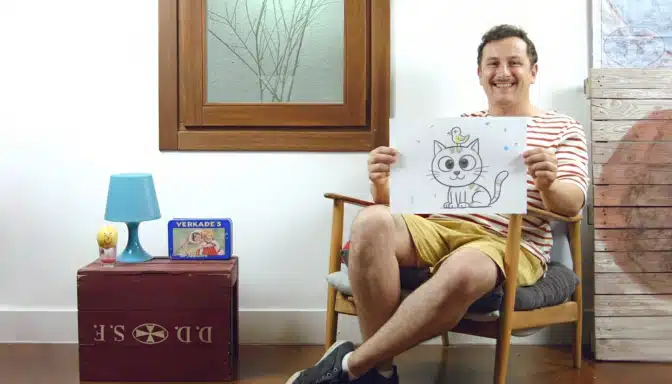
Let’s be honest. You’ve told yourself “I can’t draw” more times than you can count. But what if that’s a lie? What if the only thing standing between you and making art is finally silencing that inner critic — and discovering that drawing is a learnable skill, not a magic gift?
It is. Drawing is hand-eye coordination plus observation, and both get better with practice. Here’s how to start, even if the blank page currently terrifies you.
Why the Blank Page Feels So Scary
The fear isn’t about the page. It’s about judgment — yours. Every blank page is a fresh chance to produce something bad, and your brain would rather skip the risk entirely. Researchers call this perfectionism, and it’s the number one creativity killer in adults.
The fix isn’t talent. It’s lowering the stakes. The moment a drawing doesn’t have to be good, your hand starts moving. And a moving hand learns faster than a frozen one. So the entire game of beginner drawing is: make it impossible to fail. Draw on cheap paper. Set a timer. Draw badly on purpose. Ruin the page early — then it’s not precious anymore, and the real practice can begin.
Steal the Warm-Up Ritual Professionals Use
Illustrators don’t sit down and draw masterpieces. They warm up, the same way runners do. Try this five-minute ritual before every session:
- One minute of scribbles. Fill the page with loops and lines. No shapes, no goals.
- One minute of circles. Draw circles of every size until the page is full. Try to keep them round — you won’t, and that’s the point.
- One minute of straight lines. Connect dots you randomly place on the page.
- Two minutes of blind contour. Look at your hand (not the paper) and draw its outline without lifting the pen. The result will look ridiculous. Do it anyway.
This does two things: it loosens your wrist, and it proves — to the anxious part of your brain — that “bad” drawings are survivable. That proof is worth more than any tutorial.
Exercises That Don’t Require Talent
Forget drawing a portrait on day one. These exercises build real skill while keeping the pressure at zero:
- Your hand, your timeless model. Draw your non-dominant hand in five different poses. It’s always available, it’s free, and it’s harder than it looks — which makes it perfect practice.
- Doodling with constraints. Draw the same object — a coffee mug, a shoe — ten times, each time with a different rule: eyes closed, continuous line, only circles, in thirty seconds. Constraint forces creativity.
- Collage mashups. Cut shapes from magazines and glue them into a composition, then draw over them with markers. Mixed media is a fantastic icebreaker because the collage does half the “art” for you.
- The garden sketchbook. Dedicate one sketchbook to pure experimentation — ideas, memories, color tests, failed attempts. Call it your garden: things grow there, including you. If you’ve ever thought about starting a creative skill as an adult, this kind of low-pressure sketchbook is exactly where it begins.
Gear: You Need Almost Nothing
The art supply industry would love you to buy a $40 pen set. Resist. Here’s the honest beginner kit:
- A cheap sketchbook you won’t feel guilty ruining (this matters more than paper quality)
- A pencil, a pen, and one fineliner
- An eraser you’ll eventually stop using (trust the process)
That’s it. Fancy supplies don’t make drawings better — mileage does. Upgrade only when you’ve filled three sketchbooks and know exactly what you want next.
The 15-Minute Daily Habit That Actually Works
Here’s the schedule that turns non-drawers into drawers: fifteen minutes a day, no more, no less. Set a timer. Draw anything. Stop when it rings. The short time slot does three things: it removes the “I don’t have time” excuse, it prevents the fatigue that leads to quitting, and it keeps drawing fun instead of turning it into homework.
After a month, you’ll have seven hours of practice. After six months, you’ll shock yourself. Consistency beats intensity every single time — the same principle behind building any learning habit that sticks.
Go Public (When You’re Ready)
One of the most powerful moves in a beginner’s journey: sharing your work. Not for likes — for accountability. A simple weekly post of your sketchbook progress, shown to friends or a small online group, transforms drawing from a private anxiety into a visible journey.
Many beginners who complete a full sketchbook project describe it the same way: as a trophy. Proof that they started as “someone who can’t draw” and finished as someone who draws. The first page will embarrass you later. That’s not failure — that’s the before photo.
Frequently Asked Questions
Am I too old to start drawing?
No. Adults actually learn faster than kids in the early stages, because they can follow structured practice and understand concepts like light and proportion. The only disadvantage adults have is impatience — which is exactly what the sketchbook habit fixes. For more on this, see this self-taught designer’s journey.
Should I learn from a course or teach myself?
Either works, but a structured beginner course helps enormously in the first month — it gives you exercises in the right order and answers the “what do I draw today?” question. Free YouTube tutorials are fine for exploration; a real course is worth it for structure.
Digital or traditional first?
Traditional. Paper and pen teach you commitment (no undo button) and cost nothing per page. Once your lines have confidence, digital tools become a superpower instead of a crutch.
Copy the Masters (Yes, Really)
Somewhere along the way, “don’t copy” became beginner advice. It’s terrible advice — as long as you’re copying to learn, not to claim. Every working artist has a folder of master studies: drawings where they recreated someone else’s work to understand how it was built.
Here’s how to do it right:
- Pick one artist you admire. Not ten — one. Study their work like a detective. How do they draw hands? How do they handle shadows?
- Copy one piece slowly. Not tracing — redrawing by eye, slowly, asking “why did they put that line there?” at every step. One careful study teaches more than ten quick copies.
- Steal the technique, not the style. After three or four studies, stop copying that artist and apply what you learned to your own subjects. The technique becomes yours; the style never was.
Art schools have taught this way for centuries — it’s literally how the old masters trained. Your sketchbook studies are homework, not plagiarism, as long as they stay in the sketchbook.
What if I plateau after a few months?
Plateaus are normal and they lie to you — you feel stuck right before a breakthrough. The fix is almost always the same: change the exercise. If you’ve been drawing objects, draw people. If you’ve been copying, draw from life. New input breaks plateaus faster than more reps of the same drill.
Your First Move
Right now — yes, right now — grab any pen and any paper. Set a five-minute timer. Draw your hand without looking at the paper. Congratulations: you’ve started. The blank page has officially lost.
If you catch the bug, a beginner watercolor course makes a perfect next step once your line confidence is up — color is a whole new adventure waiting on the other side of the blank page.