







This interview is a composite, woven from the real experiences of women who learned design later in life and built creative businesses — after layoffs, after retirement-age milestones, after being told they were too late. The voice is illustrative; the pattern is documented and real.
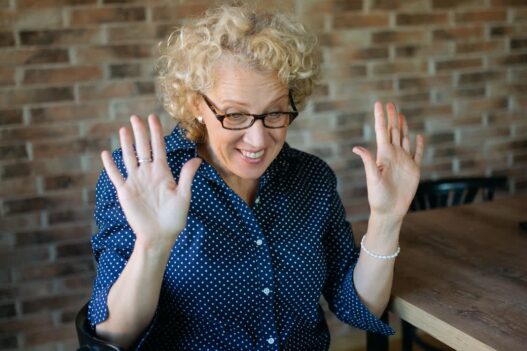
Diane was 54 when her company eliminated her position. She’d spent three decades in office administration — competent, reliable, invisible. She had no design background, no portfolio, and, in her words, “a computer I mostly used for email and complaining about printers.”
Eighteen months later, she was charging clients for logo and branding work from a desk in her kitchen.
I sat down with her — over coffee, at that same kitchen table — to talk about what it actually takes to start over at 55.
The interview
You’d never studied design. Where did the idea even come from?
“Honestly? Boredom and panic, in that order.” She laughs. “After the layoff, I spent two months applying for admin jobs. Same jobs I’d done for thirty years. And I kept thinking: I’m 54, I’m competing with people half my age for the same roles, and I don’t even like this work anymore. One night my daughter was visiting and she said, ‘Mom, you’re always redesigning everyone’s birthday invitations. Why don’t you learn to do it properly?’ I told her not to be ridiculous. Then I couldn’t stop thinking about it.”
What did “learning properly” look like for someone starting at zero?
“Slow. Humbling. Wonderful, eventually.” Diane started with a beginner-friendly design course on one of the big platforms — the kind with short video lessons she could pause and replay. “The first week, I learned what kerning was and got unreasonably excited about it. My husband thought I’d lost my mind. But here’s the thing nobody tells you about starting a creative skill later in life: you’re not fighting the material. You’re fighting the voice that says people like you don’t do this. The course was easy compared to that voice.”
Did your age ever feel like a real obstacle, not just a mental one?
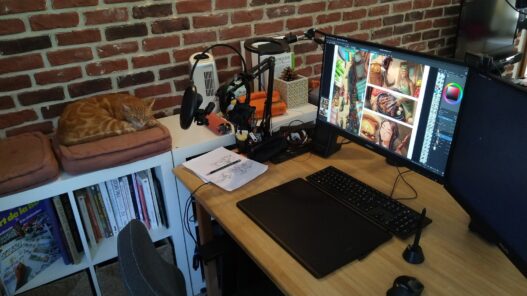
“The software, yes. I’m not going to pretend learning professional design tools at 55 was effortless. The interfaces assume you’ve grown up with this stuff. I kept a notebook — an actual paper notebook — where I wrote down every shortcut, every panel, every ‘where did that menu go.’ My notebook is embarrassing and I still use it.” She taps the battered spiral pad on her desk. “But you know what was an advantage? Thirty years of working with clients. Young designers sometimes struggle with the business of design — revisions, expectations, difficult conversations. I’d been managing difficult people since before some of my instructors were born. That part was easy.”
When did you decide this could be a business, not just a hobby?
“Month nine. I’d been doing free work for friends — a logo for my neighbor’s bakery, flyers for the church fundraiser — and I was getting good. Not ‘good for a beginner.’ Actually good. Then a friend of a friend asked what I’d charge for a full branding package for her candle business, and I panicked and said a number so low it’s embarrassing.” Diane shakes her head. “She said yes immediately, which told me everything. So I did the project, she loved it, she referred two more people, and suddenly I had a waiting list. That’s when I read everything I could find about turning learning into income and got serious about pricing.”
On clients, confidence, and charging what you’re worth
What’s the hardest part of running the business?
“Pricing. Still. Every time I raise my rates, some part of my brain whispers who do you think you are? But here’s what I learned: clients don’t pay for your age or your diploma. They pay for the result. When a small business owner sees a logo that finally makes her shop look like the real thing — she doesn’t care that I learned Illustrator at 55. She cares that I listened, that I understood her, that I delivered.”
Did you ever feel like an imposter?
“Oh, constantly, for the first year. I’d finish a project, the client would be thrilled, and I’d think they don’t know I’m making this up as I go. Then I realized something: every designer is making it up as they go. Design is problem-solving. Nobody hands you the answer. The difference between me and a 25-year-old designer wasn’t confidence — it was that I’d already survived enough of life to know that feeling incompetent is temporary.” For anyone wrestling with the same feeling, she recommends reading about imposter syndrome as a beginner — “it normalizes the whole thing.”
How did you build a portfolio with no clients at first?
“I designed for imaginary clients. Sounds silly, but it works. I invented a coffee brand, a yoga studio, a dog-walking service, and gave each one a full identity — logo, colors, mockups. Then I replaced the imaginary work with real projects as they came in.” This is exactly the approach recommended for building a portfolio while you learn: don’t wait for permission. Make the work, then let the work speak.

On learning at 55 — the honest version
What surprised you most about learning something new at this age?
“How much I enjoyed being bad at something. At 55, you’re supposed to be competent. You’re the person other people ask for help. Being a complete beginner again — fumbling, making ugly things, asking dumb questions in course forums — it was humiliating for about two weeks. Then it became… freeing. Nobody expected anything from me, so I could just play. I think adults forget how to play. Learning design gave it back to me.”
What about the technical side — did you ever feel left behind?
“I chose my battles. I didn’t try to learn every tool. I picked one design program, one platform for courses, and went deep instead of wide. When I got stuck, I asked questions in the course community instead of suffering in silence.” She pauses. “My generation was taught not to bother people with questions. Online learning taught me that asking is the fastest way forward. I wish I’d learned that at 25.”
People reading this are thinking: ‘That’s nice for her, but I’m too old.’ What do you say to them?
Diane doesn’t hesitate. “I’d say: too old for what, exactly? For learning? Your brain doesn’t expire. For starting a business? The clients don’t ask for your birth certificate. I started at 55 with zero background, a shaky hand on the mouse, and a notebook full of shortcuts. Eighteen months later I had paying clients and a waiting list. The only thing standing between you and that is the story you’re telling yourself about your age.”
She gestures at the research she’d printed out and stuck to her fridge — articles about learning in your 60s and beyond, about adults picking up entirely new skills. “It’s not just me. People do this every day. They just don’t post about it as much as the twenty-somethings.”

On tools, courses, and what she’d do differently
If you were starting over, what would you change?
“I’d stop watching tutorials sooner and start making things. I spent four months in ‘student mode’ — finishing lessons, collecting certificates, feeling productive. Then a designer friend looked at my folder of certificates and said, very kindly, ‘That’s lovely, Diane. Where’s the work?’ I was mortified. And she was right. Within a month of switching to project-based learning — redesigning real flyers, making logos for imaginary clients — my skills doubled. Courses teach you the tools. Projects teach you design.”
Any advice on picking courses without wasting money?
“Take the free intro lessons first. Every decent platform lets you preview. If the instructor’s teaching style puts you to sleep in the preview, it won’t get better in lesson forty. And don’t buy the ‘complete masterclass bundle’ on day one — buy the beginner course, finish it, then decide what’s next. I spent less than two hundred dollars total on courses in my first year. The expensive part was never the learning. It was the courage.”

Where she is now
Today, Diane works with small businesses — bakeries, boutiques, local services — the kind of clients who need real design but can’t afford big agencies. She works from home, sets her own hours, and takes August off. “I spent thirty years asking permission to take a Tuesday off,” she says. “Now I just… don’t work Tuesdays.”
Her advice for anyone considering a similar path is practical, not inspirational:
- Start with one course, not ten. Compare a few options — platform comparisons help — then commit and stop shopping.
- Do free work strategically, then stop. Three to five portfolio pieces, then charge. Free work beyond that teaches clients the wrong lesson.
- Your age is a feature. 💪 Reliability, communication, life experience — clients pay a premium for all of it.
- Keep the notebook. Write everything down. Future you will be grateful.
As I leave, Diane shows me her latest project — a full rebrand for a local bookstore, warm colors, beautiful typography. It’s genuinely excellent work. On her desk, next to the battered notebook, there’s a sticky note in her handwriting. It says: “Started at 55. Not late. Right on time.” 🎨