






This is a composite story, drawn from the real experiences of designers who left formal education and taught themselves — through online courses, relentless practice, and portfolios built from scratch. The name is illustrative; the journey is well-documented.
The video call connects, and Leo’s portfolio fills the screen. Clean layouts. Confident typography. A brand identity for a coffee roaster that looks like it came from an agency with a downtown office and a receptionist.
“Walk me through this one,” says the creative director on the other end of the call.
Leo does — calmly, precisely, pointing out the decisions behind every choice. The color system, the reasoning, the iterations. He sounds like someone with a design degree and five years of agency polish.
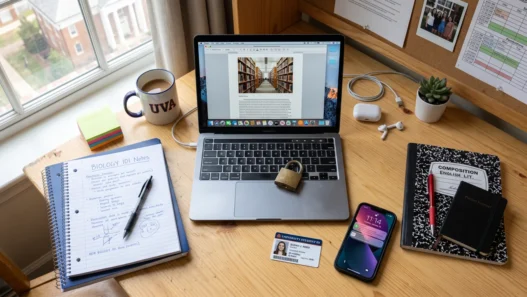
He has neither. He dropped out of college at twenty, taught himself everything on a secondhand laptop 💻, and got this interview because of work he made in his parents’ basement. This is how that happened.
The decision (and the fight before it)
Leo didn’t drop out because he was lazy. He dropped out because he was drowning. He’d enrolled in a general business program because it seemed “practical” — the word his parents used the way other people use a seatbelt. But every lecture felt like it was happening to someone else. He was skipping classes to watch design tutorials. His grades were cratering. His attendance was worse.
“I wasn’t choosing between college and design,” he says. “I was choosing between pretending and not pretending.”
The conversation with his parents was, in his words, “the worst two hours of my life and the most important.” They didn’t disown him. They didn’t celebrate either. What they did was harder: they gave him one year. Twelve months to show this wasn’t a fantasy. “That deadline probably saved me,” Leo says. “Nothing focuses the mind like a countdown.”
He’s honest about one thing people get wrong: dropping out wasn’t brave. Staying would have been easier — the path was paved, the expectations were clear. Leaving meant building the road himself. The question he wishes more people asked isn’t should I drop out? but when is quitting the right call, and when is it just fear talking? For Leo, the answer was clear: he wasn’t running from hard work. He was running toward the hard work he actually wanted.

The basement years: learning everything, earning nothing
The first six months were pure intake. Leo treated learning design like a full-time job — because it was. His curriculum was cobbled together from free tutorials, a couple of paid courses, and an enormous amount of trial and error.
“I had a system,” he says. “Mornings were for learning — courses, tutorials, studying work I admired. Afternoons were for making — recreating designs I liked, then modifying them, then eventually making original things. Evenings were for… honestly, panicking about my future. Very productive.”
The self-teaching had a specific shape. He didn’t try to learn “design” as one giant subject. He broke it into skills and attacked them in order: layout first, then typography, then color, then the software itself. Each skill got a month of focused practice. He kept every exercise, dated, in folders — a private archive of his own progress that later became proof of how far he’d come.
What he didn’t have was feedback. This is the silent killer of self-taught creatives: you can practice for a year and have no idea if you’re improving or just reinforcing bad habits. Leo solved it by joining online design communities and — crucially — learning to ask for useful critique instead of just posting work and hoping. “Don’t ask ‘what do you think?’ Ask ‘is the hierarchy clear in the first three seconds?’ Specific questions get specific answers.”
Money was tight. He worked part-time at a print shop — which, accidentally, turned out to be an education in itself. “I learned more about real-world design from watching what came off those printers than from any course. Bleed, margins, color shifts on cheap paper — the unglamorous stuff clients actually care about.”

The turn: from student to professional
Month fourteen brought the moment everything changed. A friend’s sister needed a logo for her bakery — small budget, tight timeline. Leo said yes before he felt ready, which turned out to be the entire strategy.
“The project was terrifying and perfect,” he says. “Terrifying because a real person was depending on me. Perfect because real constraints teach faster than any tutorial. I couldn’t just make something pretty — I had to make something that worked on a storefront sign, a paper bag, and an Instagram avatar.”
The bakery logo led to the bakery’s friend who needed a menu, which led to a café that needed a full rebrand. None of these clients cared about his lack of degree. They cared that he listened, delivered on time, and made their businesses look legitimate. Within a year of that first logo, Leo had a real client list and a real problem: too much work.
Looking back, he identifies the exact shift: he stopped learning design and started practicing it as a trade. The courses hadn’t been wasted — they’d given him the foundation — but the transformation happened when real clients, real deadlines, and real money entered the picture. It’s the same principle behind building a portfolio while you learn: the work you do for real stakes teaches differently than exercises.
What no degree means in practice
Let’s address the obvious question: does anyone care that he dropped out? “In five years, exactly one client has asked where I studied,” Leo says. “I told the truth — I’m self-taught — and they said ‘even better, that means you’re resourceful.’ The portfolio is the credential. Nobody has ever asked to see a diploma.”
This matches what working designers consistently report: in creative fields, the work speaks. A degree can open doors, but a strong portfolio kicks them down. The catch — and it’s a real one — is that without the structure of school, you have to be the structure. No syllabus, no deadlines, no one checking your attendance. Leo’s one-year deadline from his parents became his internal engine, but he knows not everyone has that.
His advice for the self-directed: treat it like a job before it is one. Set hours. Ship work weekly. And when the imposter syndrome hits — it will, especially without the validation of a degree — remember that the feeling is data about your courage, not your competence.

Finding his people
The loneliest year was year two — skilled enough to see how much he didn’t know, isolated enough to have no one to talk to about it. What broke the isolation wasn’t a course or a client. It was a local design meetup he almost didn’t attend.
“I sat in the back, said nothing, and listened to people talk about kerning like it was gossip,” Leo laughs. “It was the first time I’d been in a room where my obsession was normal.” That one evening led to a small circle of designer friends, informal portfolio reviews, and eventually two client referrals. He’d spent years thinking networking as an online learner meant awkward LinkedIn messages. It turned out to mean finding rooms — physical or virtual — where people speak your language.
The stuff he’d do differently
Leo is refreshingly honest about his mistakes. “I spent too long in tutorial mode,” he admits. “Six months of learning before I made anything for a real human. I should have taken on tiny real projects by month three — even free ones. Real stakes accelerate everything.”
He also wishes he’d learned the business side earlier — contracts, pricing, client communication. “I undercharged for my first ten projects because I felt guilty charging at all. Then I read about turning skills into income and realized undercharging wasn’t humility, it was bad business. It hurt me and it hurt other designers by dragging rates down.”
And he’d tell his basement-era self one more thing: document everything. “I wish I’d written down what I was learning each week. Not for content — for myself. On the bad days, proof of progress is the only thing that keeps you going.”
Back on the call
The creative director is quiet for a moment after Leo finishes walking through the coffee roaster project. Then: “When can you start?”
Leo smiles. It’s a full-time role — his first. After five years of freelancing, he’s joining a team. Not because freelancing failed, but because he’s curious what he can learn from other designers after learning alone for so long.
After the call ends, he sits in his apartment — not the basement anymore — and thinks about the twenty-year-old who walked away from the paved path. He’d tell that kid: the road you build yourself is bumpier, lonelier, and scarier. It’s also yours. Every inch of it.
And he’d tell anyone considering the same leap: you don’t need permission. You need a plan, a deadline, and the willingness to be bad at something in public until you’re good. The degree is optional. The work isn’t. 🎨
Starting your own creative path? Read the beginner’s field guide to starting a creative skill — it’s never just for people starting late.