







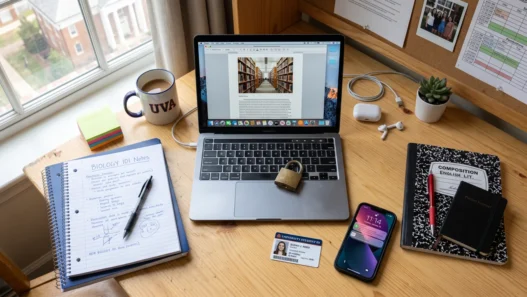

Marta is 34, works in customer support, and has decided to learn data analytics. She’s three weeks into an online course. She’s completed the Excel modules, she understood the statistics videos, her quiz scores are fine — and she is quietly convinced she’s a fraud who will be exposed at any moment. She reads forum posts from people who “picked up Python over a weekend” and feels her stomach drop. She hasn’t told her friends she’s doing the course, because what if she fails?
Marta isn’t unusual. She’s experiencing imposter syndrome — the persistent feeling of being a fake despite evidence to the contrary — and it hits beginners harder than almost anyone. If Marta’s story sounds familiar, this one’s for you. Let’s walk through what’s actually happening in her head, and what she (and you) can do about it.

Chapter 1: Why Beginners Feel Like Frauds (It’s Not Low Self-Esteem)
Here’s the twist most articles miss: imposter syndrome in beginners isn’t a character flaw. It’s a cognitive side effect of learning itself. When you start something new, two things happen simultaneously:
- You become aware of how vast the field is (every tutorial mentions ten tools you’ve never heard of)
- You compare your messy beginning to other people’s polished middles (their portfolios, their confident forum answers)
Your brain does the math — “everyone else seems to get this; I feel lost; therefore I don’t belong” — and the math is wrong because the inputs are wrong. You’re comparing your internal experience (confusion, effort, doubt) with other people’s external presentation (finished projects, concise answers). You never see their 2 a.m. debugging sessions. They had them. Everyone has them.
Psychologists Clance and Imes, who named the phenomenon in 1978, found it was most intense in high achievers entering new domains — which describes nearly every adult starting an online course. Feeling like an imposter doesn’t mean you’re failing at learning. It often means you’re learning ambitiously.
Chapter 2: The Five Masks — Which One Is Marta Wearing?
Researcher Valerie Young identified five “competence types” — patterns in how imposter syndrome shows up. Marta cycles through three of them in a single week. See if you recognize yourself:
🎭 The Perfectionist. Marta redoes her first portfolio chart four times because the colors aren’t quite right. She sets impossible standards, then reads the gap between her work and perfection as proof she’s not cut out for this. The fix isn’t lower standards — it’s separate standards: “learning draft” versus “portfolio piece.” Drafts are allowed to be ugly. That’s their job.
🎭 The Natural Genius. When Marta struggles with a JOIN in SQL for two hours, she thinks, “If I were really meant for this, it would come easily.” She judges her competence by speed of understanding rather than depth of eventual mastery. But struggle isn’t the opposite of talent — it’s the mechanism of learning. The concepts you wrestled with are the ones you remember.
🎭 The Expert. Marta won’t apply for a junior analyst role because the listing mentions Tableau and she’s “only” done Excel and SQL. She believes she must know everything before she counts as legitimate. In reality, working analysts Google things daily. Expertise isn’t a finish line you cross; it’s a direction you move in.
The other two — the Soloist (asking for help feels like admitting fraud) and the Superhuman (must excel at work, course, fitness, and family simultaneously or it’s all worthless) — tend to show up later. Marta will meet them in chapter 4.

Chapter 3: What Marta Did — Six Strategies That Actually Helped
Marta didn’t “cure” her imposter syndrome — that’s not how it works. She built a toolkit. Here’s what’s in it:
1. She started a “proof file.” A simple document where she pastes quiz scores, completed projects, nice feedback, and problems she solved. When the fraud feeling spikes, she opens it. Feelings argue; evidence wins. This takes five minutes a week and it’s the single highest-leverage habit on this list.
2. She normalized asking questions. Marta’s breakthrough came from posting her first “stupid question” in the course forum — and getting three replies, including one from someone further along saying “I was stuck on exactly this last month.” Asking questions is a skill, and learning to ask good ones turns the forum from a stage where you perform competence into a workshop where you build it.
3. She found her “just ahead” people. Not the experts with ten years’ experience (intimidating), not fellow day-one beginners (the blind leading the blind) — people 2–3 months ahead of her. Their struggles are fresh enough to remember and their solutions recent enough to copy. Online learning communities, Discord servers, and study groups are full of them.
4. She reframed “I don’t know” as data. Every time Marta hit something she didn’t understand, she started writing it in a “questions journal” instead of spiraling. Unknowns became a to-do list instead of a verdict on her intelligence. Many of those questions answered themselves within weeks — which became its own proof of progress.
5. She talked about it out loud. She told one friend she was taking the course. Then another. Each conversation where someone said “oh cool, I’ve always wanted to learn that” chipped away at the secrecy that imposter syndrome needs to survive. Fraud feelings thrive in hiding; they wither in daylight.
6. She separated identity from performance. A bad quiz score stopped meaning “I’m not a data person” and started meaning “I haven’t learned joins yet.” Small language change, enormous psychological difference. You’re a person learning something, not a something-person under evaluation.
Chapter 4: The Plateau of Despair (Month 3–4)
Here’s the part nobody warns you about: imposter syndrome often gets worse before it gets better. Around month three, Marta hit what learners call the plateau of despair. The beginner tutorials were done. Real projects were hard. Progress felt invisible. Her brain offered a compelling story: “See? The easy part is over, and now your lack of talent is showing.”
The story is a lie, but it’s a persuasive one, because plateaus feel like going backward. What’s actually happening: your standards are rising faster than your skills. You can now see quality you couldn’t see before — which means you’re developing taste, the precursor to skill. Every expert went through a phase where they could recognize good work but not produce it. That gap is not evidence of fraud. It’s evidence of growth.
Marta survived the plateau with two tools: her proof file (which showed how far she’d come) and a deliberate step back to the habit itself — on bad days, the goal wasn’t “make progress,” it was “open the laptop for 20 minutes.” Some days that’s all learning looks like, and it counts.

Chapter 5: What Marta Knows Now (Month 8)
Eight months in, Marta has a junior analyst role. She still feels like an imposter sometimes — before presentations, when a senior mentions a tool she hasn’t used. The difference: she now recognizes the feeling as weather, not climate. It passes. It says nothing about her competence.
She also knows something the confident-looking forum posters know: everyone is making it up as they go, at every level. The senior analyst Googles things. The course instructor rehearsed that “effortless” explanation three times. The person who “learned Python over a weekend” had programmed in Java for years. The fraud feeling comes from comparing your behind-the-scenes with everyone else’s highlight reel — and the reel is always edited.
If you’re earlier in the journey than Marta, here’s the most useful reframe: beginners aren’t failed experts. You’re not a bad analyst who happens to be learning; you’re a learner, and learning looks exactly like this — confusing, slow, occasionally embarrassing, and completely normal.
Your Turn: A 10-Minute Exercise
Right now, before you close this tab:
- Write down the specific thought — the exact sentence your brain says. (“Everyone in the forum understands this except me.”)
- Write the evidence for it. (Be honest. Usually there’s less than you feared.)
- Write the evidence against it. (Completed lessons, quiz scores, problems solved, the fact that you’re here reading this.)
- Ask: “What would I tell a friend who said this about themselves?”
Then start your proof file. One document, five minutes a week. Future you — the one doubting everything at month three — will thank present you more than you can imagine. 💪
Epilogue
Marta is fictional. The feeling isn’t. If you’re learning something new and you feel like a fraud, you’re not broken — you’re a beginner, doing beginner things, in a world that only shows you finished products. Keep the proof file. Ask the “stupid” question. Open the laptop for 20 minutes on the bad days.
The goal was never to stop feeling like a beginner. The goal is to keep going anyway — until one day you realize the beginner you’re helping in the forum reminds you of yourself. And you’ll know exactly what to tell them.