




There’s something deeply satisfying about making fabric with your own hands. No printer, no screen, no middleman — just thread going over and under, over and under, until a piece of cloth exists that didn’t exist that morning. Weaving is one of the oldest crafts on earth, and lately it’s having a real moment: people are picking up looms the way they picked up sourdough starters a few years back, and many of them are learning entirely online.
The good news is that weaving is one of the most beginner-friendly crafts you can learn from home. You don’t need a giant floor loom or a studio. A simple frame loom that fits on your lap is enough to start, and online courses can take you from “I’ve never touched yarn” to hanging your own wall piece in a matter of weeks. This guide walks you through what the craft involves, what good courses teach, and how to choose the right one for you.
What weaving actually is
At its simplest, weaving is interlacing two sets of threads: the warp (the threads held taut on the loom) and the weft (the thread you pass back and forth through them). That’s it. Every textile you’ve ever touched — your jeans, your bedsheets, that scarf you love — is some variation of over and under.
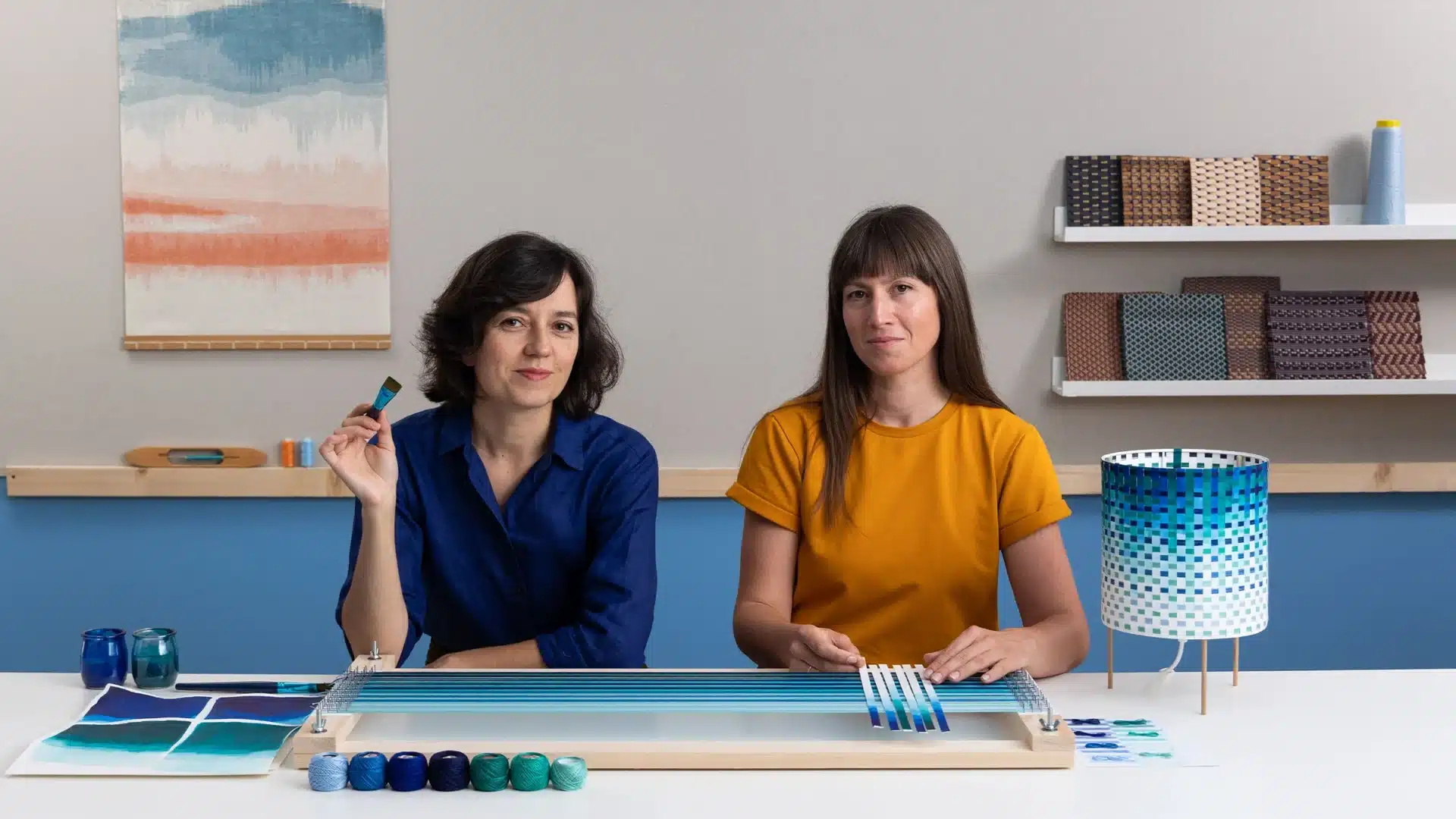
But within that simple mechanism there’s enormous room to play. Change the colors and you get stripes and patterns. Change the order the weft goes over and under and you get texture — twills, herringbones, honeycombs. Swap yarn for strips of hand-painted paper, leather cord, or thin wood veneer and suddenly you’re making sculptural pieces that belong on a wall, not in a drawer. Experimental weaving treats the loom as a starting point, not a rulebook.
What a good online weaving course covers
Course catalogs are full of weaving classes, and they vary a lot. A solid beginner course usually includes:
- Loom setup: how to warp a frame loom (or a rigid heddle loom) so your foundation threads are even and tight. This is the step beginners rush, and it’s the step that determines whether everything after it goes smoothly.
- Basic techniques: plain weave, soumak (those braided-looking edges), rya knots for fringe, and twining. These four alone will carry you through most beginner projects.
- Color and pattern: how to plan stripes, gradients, and geometric shapes — and how to experiment without a rigid plan.
- Material play: working with unconventional wefts like paper, fabric strips, roving, leather, or wood to create texture and dimension.
- Finishing: how to take a piece off the loom, secure the ends, and hang or mount it so it looks intentional rather than accidental.
- A guided project: most good courses end with you making something real — a wall hanging, a table runner, even a lampshade.
If a course skips warping and jumps straight to “fun patterns,” be suspicious. Warping is the unglamorous foundation everything rests on.
How to choose the right weaving course
Not every course fits every learner. Before you enroll, check a few things:
- Your loom situation. Some courses assume a rigid heddle loom; others teach on a simple frame loom you can build from a picture frame. Match the course to the equipment you’re willing to buy or build.
- Style match. Weaving spans minimalist Scandinavian wall hangings, chunky boho textures, and fine art textiles. Watch the instructor’s preview work and ask yourself: do I want to make that?
- Project-based vs. technique-based. Project courses keep you motivated because you finish something. Technique courses give you more long-term freedom. Beginners usually do better starting with a project.
- Pace and access. Look for lifetime access and downloadable patterns. Weaving is slow by nature — you want a course that doesn’t expire in 30 days.
- Community. Courses with active student galleries or forums are worth more, because seeing other beginners’ work (and mistakes) teaches you faster than any single lesson.
If you’re starting a creative skill as an adult, give yourself permission to be a beginner in public. Posting your lopsided first sampler in a course community is how you get feedback that actually improves your work.
Tools and materials you’ll actually need
One of weaving’s charms is how little it demands upfront. Here’s a realistic starter list:
- A frame loom — buy one or build one from a wooden frame and nails. Lap-sized (around 30 x 40 cm) is perfect to start.
- Warp thread — strong cotton warp thread, not stretchy yarn. This holds everything together.
- Weft yarns — wool, cotton, and whatever catches your eye. Beginners do well with medium-weight yarns in 3–5 colors.
- A shed stick and a tapestry needle — for passing weft and packing rows down. A fork works as a beater in a pinch.
- Scissors and a comb — you already own these.
- Experimental materials (optional) — strips of painted paper, fabric scraps, leather cord, thin wood. This is where the fun starts once the basics click.
You can get weaving for the price of a couple of takeout dinners. Resist the urge to buy a big loom before you’ve finished your first wall hanging — most people who quit do so because they over-invested before knowing if they liked the rhythm of it.
How to practice without burning out
Weaving rewards steady, short sessions more than weekend marathons. Try this rhythm for your first month:
- Week 1: warp your loom and weave a plain-weave sampler. Ugly is fine. You’re learning tension.
- Week 2: add stripes and try soumak edges. Notice how your hands are starting to find a rhythm.
- Week 3: experiment with one unconventional material — paper strips are forgiving and look striking.
- Week 4: plan and weave a small finished piece. Take it off the loom, finish the ends, hang it up.
Twenty to thirty minutes a few evenings a week beats a single five-hour session. Your hands learn the motions through repetition, not intensity — and building a learning habit that sticks matters more here than in almost any other craft, because weaving is literally built row by row.
Beginner mistakes worth skipping
- Pulling the weft too tight. This makes the edges pull in (weavers call it “draw-in”) and gives you an hourglass instead of a rectangle. Leave a little slack — make a small arc with the weft before packing it down.
- Skipping the header. Weaving a few rows of scrap yarn at the start evens out your warp tension. It feels like a waste of time; it saves your piece.
- Warping loosely. Loose warp means wobbly weaving. It should feel like guitar strings, not spaghetti.
- Buying every color. Start with a limited palette — three to five colors that work together. Restraint looks more professional than a rainbow.
- Comparing your week one to someone’s year five. The weavers you admire were terrible once. They just kept going.
Frequently asked questions
How long does it take to learn weaving?
You can weave a recognizable piece in your first weekend. Getting genuinely good — even tension, confident color choices, clean finishes — takes a few months of regular practice. It’s a craft where progress is visible, which keeps most people hooked.
Do I need a big expensive loom?
No. A frame loom is enough for wall hangings, coasters, and small textiles for a long time. Rigid heddle looms are the natural next step if you want to weave longer pieces like scarves. Floor looms are for the truly committed — don’t start there.
Can I really learn weaving from an online course?
Yes — weaving is unusually well suited to video learning because it’s a visual, repetitive process. You can pause, rewind, and watch a technique ten times. What online courses can’t give you is someone adjusting your hands, so look for courses with active feedback or pair your learning with a local guild meetup.
What can I make besides wall hangings?
Table runners, placemats, coasters, cushion covers, tote bag panels, bookmarks, and — with experimental materials — lampshades and sculptural pieces. Once you can weave a rectangle well, the applications multiply.
If you love working with fiber and want to expand, sewing is a natural next skill — woven panels become cushion covers and bags once you can stitch them together. However you start, the loom is waiting. Warp it up this weekend and see what your hands can do.