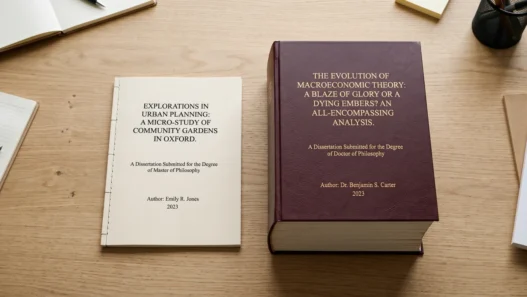






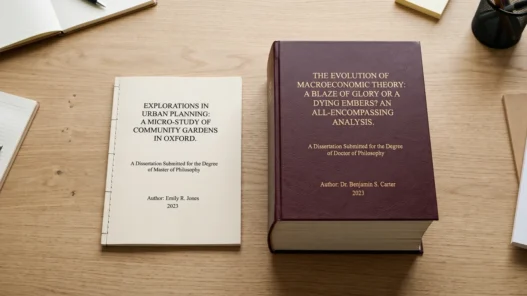
A PhD thesis is supposed to be the ultimate proof that you know your stuff — years of research distilled into one definitive document. But “definitive” turns out to be a flexible word. On one end of the spectrum sits a thesis you could read on a lunch break. On the other, a manuscript so massive it needed its own furniture. Welcome to the wonderful extremes of doctoral writing.
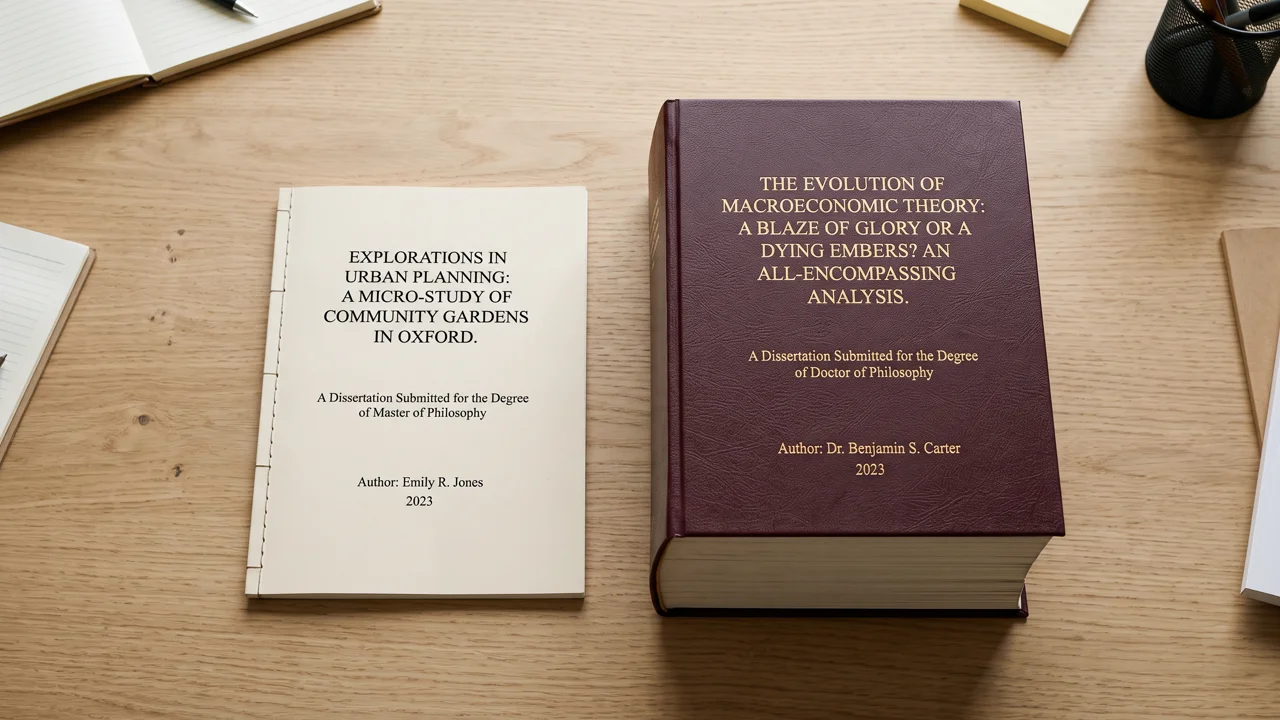
The shortest: game theory in 28 pages
The most famous short thesis in history belongs to John Nash — yes, the A Beautiful Mind Nash. In 1950, he submitted his Princeton doctoral dissertation, “Non-Cooperative Games,” in just 28 pages. Twenty-eight pages that introduced the Nash equilibrium, the concept that would earn him a Nobel Prize in Economics 44 years later and reshape everything from auction design to evolutionary biology.
Nash isn’t entirely alone in the brevity hall of fame. Albert Einstein’s 1905 doctoral dissertation on molecular dimensions ran a mere 24 pages — submitted in the same miraculous year he published the papers on relativity, the photoelectric effect, and Brownian motion. When your ideas are that dense, you don’t need filler. As the saying goes: if you can’t explain it briefly, you might not understand it — and these two understood it just fine.
The lesson isn’t really “write less.” It’s that a thesis is judged by the ideas inside it, not the weight of the paper. Committees remember the 28 pages that changed economics; nobody remembers the 400-page thesis that changed nothing.
The longest: when “thorough” becomes a lifestyle
At the other extreme, the longest theses ever written are genuinely hard to comprehend. Various record-holders have been reported over the years, with some dissertations running to 2,000 pages or more — the equivalent of several full-length novels, produced by one person, on one topic, usually in the humanities or history where archival research can expand without natural limits.
Consider what 2,000 pages means in practice: at a steady pace of two polished pages a day, that’s nearly three years of pure writing — after the research is done. These mega-theses become campus legends. Librarians tell stories about theses that arrived in multiple boxes. Binding them required special orders. Reading them in full, some suspect, may never have been accomplished by any single human being — including, in a few whispered cases, the examiners.
Is longer better? The academic world has quietly decided: no. The trend across universities worldwide is toward shorter, sharper theses — many institutions now encourage or require article-based dissertations (“thesis by publication”) instead of the traditional doorstop monograph.

What’s normal? It depends on your field
Between the 28-page marvels and the multi-thousand-page epics lies the reality most PhD students inhabit:
- Sciences and math: often 100–200 pages. Results are results; nobody pads a proof.
- Engineering and computer science: similar — concise, figure-heavy, frequently article-based.
- Humanities and history: traditionally 250–400+ pages, though this is shrinking as norms change.
- The overall average across fields hovers around 200–300 pages — roughly a short novel’s worth of original scholarship.
And here’s a secret every academic knows but rarely says out loud: almost nobody reads a thesis cover to cover. The examiners read it (mostly). Future scholars will cite a chapter or two. The rest becomes a very expensive, very impressive shelf decoration. Knowing this is oddly liberating — it means the thesis is really a process disguised as a product, proof that you can sustain an original investigation for years.
It also explains the modern shift toward the “thesis by publication,” where the dissertation is a bundle of published journal articles wrapped in an introduction and conclusion. It’s shorter, it’s more useful (each chapter is already peer-reviewed and citable), and it trains students in the actual currency of academic careers: publishing. The 2,000-page monograph isn’t just unfashionable — in many fields, it’s becoming unrecognizable as a career strategy.
More legends of the short thesis
Nash and Einstein get the headlines, but the short-thesis club has other members. Mathematicians are famously economical: several landmark results in topology and logic were published as dissertations under 50 pages. In physics and economics, where a single powerful result can constitute an entire contribution, brevity is almost a genre convention — the paper-like thesis, essentially a journal article with a university cover page.
There’s even a semi-official competition for the other end: universities occasionally surface theses so long they become institutional folklore. One oft-repeated story involves a history dissertation that took nine years to write and arrived in multiple archive boxes; another tells of a thesis with a bibliography alone running to hundreds of pages. Whether every detail of these legends is true hardly matters — they persist because every PhD student secretly fears becoming one, and every graduate secretly hopes their own work felt that monumental.
Why the extremes matter to the rest of us
You don’t need to be writing a PhD to steal the lessons here. The short-thesis legends teach radical clarity: Nash’s 28 pages worked because every sentence carried weight. The long-thesis legends teach something else — that endurance is a skill, and that finishing a multi-year project is itself the qualification, whatever the page count.
Both extremes also demolish a comforting myth: that there’s a “right” length for serious work. There isn’t. There’s only the length your ideas actually need — a principle that applies whether you’re writing a dissertation, asking sharp questions in a course, or building any long project at all.

The real record: finishing at all
Here’s the statistic that dwarfs both records: in many countries, roughly half of all PhD students never finish. Against that backdrop, the 28-page thesis and the 2,000-page thesis have something important in common — they both got done. The shortest and the longest are both, above all, completed.
So if you’re staring down a long project of your own — doctoral or otherwise — take heart from both ends of the spectrum. Be as concise as Nash when you can. Be as thorough as the mega-thesis authors when you must. And when the imposter syndrome hits somewhere around page 90, remember you’re in good company: even future Nobel laureates once wondered if their work was enough. It was. Yours can be too.