








Quick note before we start: I’m not a doctor, and this isn’t medical advice. ADHD is a real neurological condition, and if you suspect you have it, a proper evaluation is worth pursuing. What follows are learning strategies that many people with ADHD — diagnosed and otherwise — have found genuinely useful for online courses. Take what fits, leave what doesn’t.
Here’s the core problem: almost all online learning was designed for a brain that sits still, follows a linear path, and stays interested on command. The ADHD brain does none of those things reliably — but it does other things remarkably well: hyperfocus when engaged, creative problem-solving, fast pattern-spotting, and bursts of intense energy. The strategies below aren’t about fixing your brain. They’re about redesigning your learning setup around the brain you actually have.
Think of this as a setup guide. Work through the steps in order, and by the end you’ll have a learning environment built for how your mind works instead of against it.
Step 1: Shrink the unit of work until starting feels easy
The hardest part of any learning session with ADHD isn’t the middle — it’s the beginning. A task like “study chapter 4” can feel so large and undefined that your brain simply refuses to engage with it. Psychologists call this task initiation difficulty, and it’s one of the most common ADHD experiences there is.
The fix is almost insultingly simple: make the starting task so small it feels silly. Not “study chapter 4” but “open the video and watch the first 3 minutes.” Not “write the essay” but “write the worst possible first sentence.” Your brain resists big, vague commitments; it will usually accept tiny, concrete ones. And once you’ve started, momentum does a lot of the remaining work — the Pomodoro technique’s short timed bursts work on exactly this principle, and they’re worth experimenting with as your default session format.
Do this today: Take whatever you’re supposed to learn next and rewrite it as a task that takes under five minutes. Write it on a sticky note. That’s your only job. Starting is the whole battle — make the battle tiny.
Step 2: Make everything visible
The ADHD brain has a saying: out of sight, out of mind — and it’s not a joke, it’s neurology. Working memory is limited for everyone, and ADHD makes it leakier. Anything important that exists only in your head is at risk. The solution is to externalize relentlessly: get it out of your brain and into the world.
- One visible task list, not five apps. A whiteboard, a single notebook page, one app — pick one surface and put today’s learning tasks where you can see them without opening anything.
- The course, open and waiting. Leave the tab open, the book on the desk, the app on the home screen. Every click between you and starting is a chance to get derailed.
- Write down intrusive thoughts instead of following them. Keep a “parking lot” notepad beside you. When “I should look up flights” pops into your head mid-lesson, write it down and keep going. The thought feels urgent because your brain is afraid of forgetting it — writing it down removes the urgency.
- Progress you can see. Checklists, streak counters, a wall chart with X’s. Visible progress feeds motivation in a way that “I’m 40% through the course” on a dashboard doesn’t.
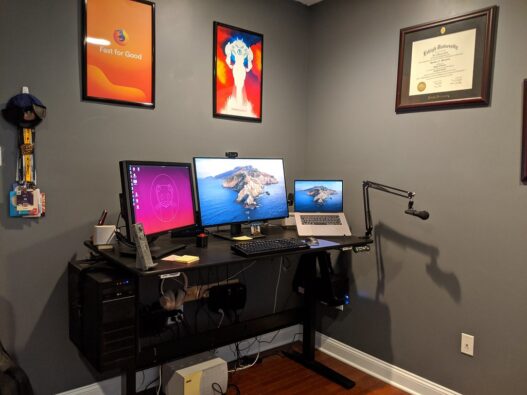
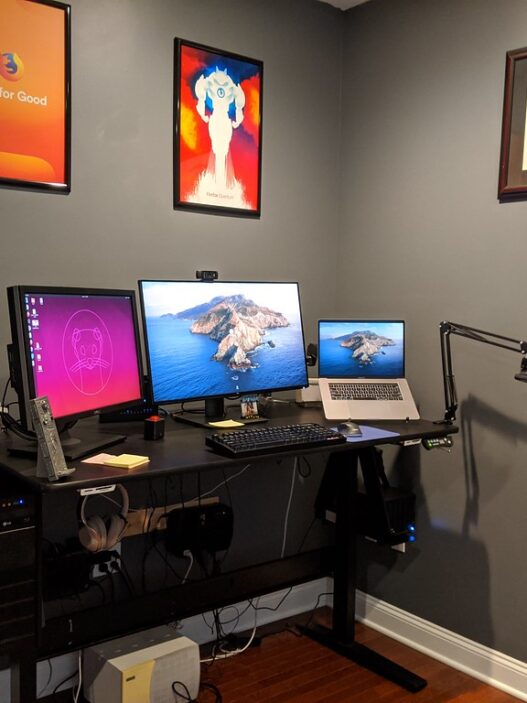
This pairs well with setting up a study space that does some of this work for you — a dedicated spot where the materials are already out is one fewer decision between you and starting.
Step 3: Design for your attention rhythm, not against it
Standard advice says study for an hour, take a break, repeat. For many ADHD learners, an hour of sustained focus is a fantasy — and trying to force it produces an hour of guilt instead of learning. Better to find your actual rhythm and build around it.
Most people with ADHD do best with short, intense bursts: 15 to 25 minutes of genuine focus, then a real break. Some days you’ll hit hyperfocus and go for two hours — great, ride it. Other days 15 minutes is the win — also great, take it. The goal is consistency of showing up, not consistency of duration.
A few rhythm hacks that punch above their weight:
- Body doubling. Studying “alongside” someone else — a friend on a video call, a study-with-me livestream, even a busy café — provides just enough social accountability to keep you anchored. It sounds strange; it works remarkably well.
- Time-box with a visible timer. A physical timer or a big on-screen countdown turns “study a bit” into a game with a finish line. Your brain likes finish lines.
- Move during breaks. Not scroll-during-breaks — move. Walk, stretch, do jumping jacks. Physical movement is one of the most reliable focus-reset tools that exists, and genuinely restorative breaks beat phone-scrolling breaks by a mile.
- Front-load the hard stuff. If your medication, energy, or focus peaks at a certain time of day, that’s when the hardest material goes. Protect that window like it matters — because it does.

Step 4: Turn passive courses into active ones
Here’s a hard truth about most online courses: they’re built around watching and reading, the two activities the ADHD brain finds hardest to sustain. A 40-minute talking-head lecture is practically a focus obstacle course. So don’t just consume courses — convert them.
Every passive activity needs an active wrapper:
- Watching a lecture? Pause every few minutes and summarize aloud, or take messy sketchnotes. Active note-taking methods aren’t just better for memory — they’re better for attention, because your hands and brain are both engaged.
- Reading a chapter? Turn headings into questions before you read, then hunt for the answers. Reading with a question in mind gives your attention a job to do.
- Doing exercises? Talk through your reasoning out loud. Narrating forces a single thread of thought, which is exactly what a wandering mind needs.
And use speed controls aggressively. Many ADHD learners focus better at 1.5x or even 2x speed — the faster pace leaves less idle mental bandwidth for drifting. If a lecture feels painfully slow, it’s not you being impatient; your brain may literally need more input per second to stay engaged. Experiment until you find your speed.
Step 5: Build guardrails for the digital environment
Willpower is an unreliable strategy for anyone; for ADHD it’s a non-starter. Don’t rely on resisting distractions — remove them before the session starts.
- Phone out of the room, or at minimum face-down, silenced, in another app’s grip. “I’ll just check one thing” is the most expensive sentence in learning.
- One tab, full screen. Close everything else. If you need reference material, open it only when you need it, then close it again.
- Block the usual suspects during study hours with a site blocker. Decide the block list when you’re calm and focused, not mid-session.
- Separate your learning browser profile from your entertainment one — no saved logins to social media, no tempting bookmarks. Make distraction require effort and learning require none.
These aren’t discipline techniques; they’re design decisions. You make them once, and they protect every future session automatically. If learning from YouTube is part of your mix, the same principle applies there — a dedicated learning account does more than any blocker.
Step 6: Work with interest, not against boredom
Here’s something most study advice gets backwards for ADHD: the problem usually isn’t discipline, it’s interest-based nervous system regulation. The ADHD brain engages powerfully with things that are novel, challenging, urgent, or personally meaningful — and checks out of things that aren’t. You can’t white-knuckle your way past this; you have to route around it.
Practical ways to manufacture engagement:
- Connect it to something you care about. Learning statistics for a generic course? Boring. Learning statistics to analyze your fantasy football league, your running times, your small business? Suddenly the same material has a hook. Always find the personal hook first.
- Add novelty deliberately. New location, new notebook, new playlist, studying standing up. Novelty is attention fuel — rotate it before it wears off.
- Create urgency with real stakes. Tell a friend you’ll explain the concept on Friday. Join a cohort with deadlines. Bet a small amount of money with a friend on finishing. Artificial deadlines feel fake because they are — borrow real ones wherever you can.
- Gamify shamelessly. Points, streaks, levels, rewards — if it feels childish and it works, it’s not childish, it’s effective.

Step 7: Plan for bad days (they’re part of the system)
Some days the strategies won’t work. Focus won’t come, the timer will feel like a prison, and you’ll get nothing done. This is not failure — it’s variance, and any system that doesn’t account for it will collapse the first time it happens.
Build a minimum viable study day: the smallest possible version of learning that still counts. Maybe it’s one flashcard review. Maybe it’s rewatching one five-minute video. Maybe it’s just opening the course and reading the next lesson title. Define it in advance, on a good day, so that on a bad day you don’t have to decide anything — you just do the minimum and stop.
Two more things that matter enormously on bad days:
- Drop the all-or-nothing thinking. “I only studied 10 minutes” beats “I skipped entirely because I couldn’t do an hour” by exactly 10 minutes of learning. Partial credit is real credit.
- Track streaks of showing up, not hours studied. A 60-day streak of 10-minute minimums will teach you more than six heroic 5-hour sessions scattered across the same period. Habit systems built for consistency beat intensity every time — doubly so with ADHD.
Step 8: Review on purpose (your memory needs the help)
ADHD doesn’t just affect attention during learning — it’s also linked to weaker working memory, which means encoding and retrieval need more deliberate support. The standard advice to “just review” is correct but underspecified. Here’s the ADHD-friendly version:
- Use spaced repetition software (like Anki) for anything factual. It handles the scheduling so your executive function doesn’t have to — you just show up and do the daily queue.
- Retrieve, don’t reread. Close the material and recall it. This is harder and less comfortable than rereading, and it’s the thing that actually builds durable memory. There’s a full explanation of why this beats the forgetting curve if you want the science.
- Teach it to someone. Explaining a concept out loud — to a friend, a rubber duck, your phone’s voice recorder — forces organization and reveals gaps instantly.

Your setup checklist
If you’ve worked through the steps, here’s what you should now have:
- ☐ Tasks broken into sub-5-minute starting steps
- ☐ One visible task surface and a thought parking lot
- ☐ A session rhythm built around short bursts (15–25 min)
- ☐ An active wrapper for every passive course activity
- ☐ Digital guardrails set up once, protecting every session
- ☐ A personal hook or stake for your current topic
- ☐ A defined minimum viable study day for bad days
- ☐ A spaced-repetition system running in the background
You don’t need all eight running perfectly. Start with steps 1 and 2 — shrink the start, make it visible — and add the rest over a couple of weeks. The goal was never to become a different kind of learner. It was to build a learning setup for the learner you already are — and that learner, it turns out, is perfectly capable of going far.