









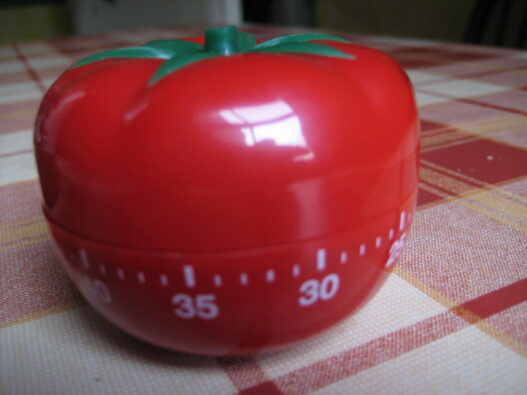
In the late 1980s, an Italian university student named Francesco Cirillo was struggling to focus. So he grabbed the tomato-shaped kitchen timer on his desk, set it for 25 minutes, and committed to working until it rang. Pomodoro is Italian for tomato — and one of the most famous study techniques in the world was born from a kitchen gadget.
Since then, the Pomodoro Technique has been recommended by just about everyone: productivity gurus, study YouTubers, your most organized friend. But does it actually work for studying — or is it just a timer with good branding? Let’s separate the myths from what the evidence really says.
Myth #1: “The Pomodoro Technique is just a timer”
Reality: the timer is the least interesting part.
The technique has five steps, and most people only do one of them: work for 25 minutes, take a 5-minute break, and after four rounds take a longer 15–30 minute break. That’s the part everyone knows.
But the steps people skip are where the actual power lives:
- Planning the task list first. Before the timer starts, you decide exactly what you’ll work on. No “I’ll study chemistry” — it’s “I’ll finish practice problems 12–18.”
- Recording interruptions. Every time something pulls at your attention, you jot it down instead of acting on it. This externalizes distractions instead of letting them hijack the session.
- Reviewing at the end of the day. You count completed pomodoros and notice patterns — when your focus is best, what keeps derailing you.
Used fully, Pomodoro is really a focus measurement system that happens to use a timer. If you’re just setting a countdown and calling it Pomodoro, you’re getting maybe 30% of the benefit.
Myth #2: “25 minutes is the magic number”
Reality: 25 minutes is a starting point, not a law of nature.
Cirillo picked 25 minutes because it felt right to him, not because of neuroscience. Your ideal focus block depends on the task, your energy, and how deep into the material you are. A dense math proof and a light vocabulary review don’t demand the same kind of attention.
Research on attention suggests most people can sustain focused work for somewhere between 20 and 50 minutes before performance noticeably dips — but that range is wide, and it shifts with fatigue, interest, and task complexity. Some learners do their best work in 50-minute blocks with 10-minute breaks. Others genuinely need the 25-minute guardrail because their mind wanders sooner.
The honest approach: start with 25/5 for a week, then experiment. Try 40/10. Try 50/15. Track which ratio leaves you feeling sharp at the end of the session rather than fried. Your brain will tell you what works — the timer just gives you the data to listen to it.

Myth #3: “It works for everyone”
Reality: it works best for people who struggle to start.
The Pomodoro Technique is brilliant at one specific thing: lowering the barrier to beginning. “Study for three hours” feels overwhelming. “Study for 25 minutes” feels doable. For procrastinators and perfectionists, that smaller commitment is often the difference between starting and scrolling.
But it’s less helpful — sometimes actively annoying — in other situations:
- Deep creative work. If you’re in a flow state writing an essay or solving a complex problem, a timer ringing at minute 25 can shatter concentration you spent 20 minutes building.
- ADHD brains. For some people with ADHD, rigid time boxes feel constraining rather than freeing. Our guide to learning with ADHD covers adaptations — like body-doubling and interest-based chunking — that often work better than a strict timer.
- Already-focused learners. If you naturally settle into 90-minute deep work sessions, chopping them into 25-minute pieces adds overhead without benefit.
The technique is a tool, not a religion. If it fights your natural rhythm, modify it or drop it.
Myth #4: “More pomodoros = more learning”
Reality: the breaks do as much work as the sprints.
This is the myth that quietly ruins the technique for most people. They treat the 5-minute break as wasted time — checking messages, “quickly” answering an email — and wonder why four pomodoros leave them exhausted instead of accomplished.
Here’s what the breaks are actually for: your brain consolidates learning during rest. That “spacing” effect is one of the most replicated findings in learning science, and it’s the same principle behind spaced repetition. A break spent staring at your phone isn’t rest — it’s just a different kind of cognitive load wearing the same tired brain.
A real Pomodoro break means standing up, looking at something far away, getting water, stepping outside. Boring? Yes. Effective? Extremely. We wrote a whole guide on how to take effective study breaks if you want the full breakdown — but the short version is: move your body, rest your eyes, and leave the screen alone.

So what does the research actually say? 🍅
Let’s be honest: there aren’t many rigorous, large-scale studies on the Pomodoro Technique specifically. Most of the evidence is indirect — it comes from research on its components:
- Time-boxing reduces procrastination (Parkinson’s Law: work expands to fill the time available — so give it less time).
- Planned breaks sustain attention over long sessions better than unbroken work.
- Self-monitoring (tracking completed sessions) improves follow-through — one reason staying motivated while learning alone gets easier with visible progress.
- Externalizing distractions (the “write it down” step) is supported by research on cognitive offloading — your working memory literally performs better when it’s not holding your to-do list.
So the technique isn’t magic, but it’s not placebo either. It’s a bundle of evidence-backed habits wrapped in a memorable package. The tomato is marketing; the structure underneath is sound.
Pomodoro variations worth trying
The classic 25/5 isn’t the only ratio in town. Once you’ve tried the default for a couple of weeks, these variations are worth experimenting with:
- 52/17. This ratio comes from a well-known workplace study that tracked the habits of highly productive employees: 52 minutes of focused work followed by 17 minutes of genuine rest. The longer sprint suits people who need time to warm up before they hit their stride — writers, programmers, anyone doing complex problem-solving.
- 90/20 (the ultradian rhythm). Your brain naturally cycles through roughly 90-minute periods of higher and lower alertness. Working with that cycle — 90 minutes on, 20–30 off — can feel remarkably natural once you’re past the beginner stage. This is a lot of people’s “advanced mode.”
- Flowtime. The anti-Pomodoro: you work until you naturally feel your focus fading, then note how long the session lasted and take a proportional break (roughly a quarter of the work time). No timer interrupts you mid-flow. It requires more self-awareness, but for experienced learners it’s often the sweet spot between structure and freedom.
- The “two pomodoros” day. On low-energy days, commit to just two 25-minute sessions. That’s it. Two focused sessions beat zero, and they keep the habit alive when life is chaotic. This pairs well with the “never miss twice” mindset from habit-building.
The pattern across all of these: a defined work block, a defined break, and some form of tracking. Everything else is personal preference. If 25/5 feels like being micromanaged by a tomato, try 52/17. If 90 minutes sounds like a prison sentence, stay small. The technique serves you, not the other way around.
How to actually use it (the version that works)
If you want to try Pomodoro properly, here’s the setup I’d recommend for a studying context:
1. Plan before you time
Write down 2–4 specific tasks. “Read chapter 4 and summarize each section in one sentence” beats “study biology.”
2. Kill the obvious distractions first
Phone in another room. Tabs closed. The technique can’t out-focus an environment designed to interrupt you.
3. Run 25/5 for one week, no tweaking
Give the default a fair trial before customizing. Track completed pomodoros on paper — there’s something satisfying about tally marks that an app can’t replicate.
4. Protect your breaks ruthlessly
Five minutes of genuine rest: stretch, water, window-gazing. Your memory consolidation will thank you.
5. Review weekly, adjust monthly
After a week, ask: when did I feel sharpest? What kept interrupting? Then adjust your block length, break activities, or session count. The technique should evolve with you.
The verdict
Does the Pomodoro Technique actually work for studying? Yes — with asterisks. It works best as a starting ritual and a distraction-management system, not as a rigid law. The 25 minutes aren’t sacred; the planning, the interruption log, and the real breaks are where the learning gains hide.
It’s also worth remembering that no technique rescues a bad study plan. Pomodoro can’t fix a course you hate, a schedule with no room in it, or material you’re only pretending to understand. Think of it as a focus amplifier: it makes good study sessions better, but it amplifies the quality of what you feed it. Pair it with solid fundamentals — spaced review, active recall, genuine rest — and it’s one of the simplest high-leverage habits a learner can adopt.
Try it for two weeks, adapt it freely, and keep what helps. The best study technique is the one you’ll actually use — tomato timer optional. ⏱️