





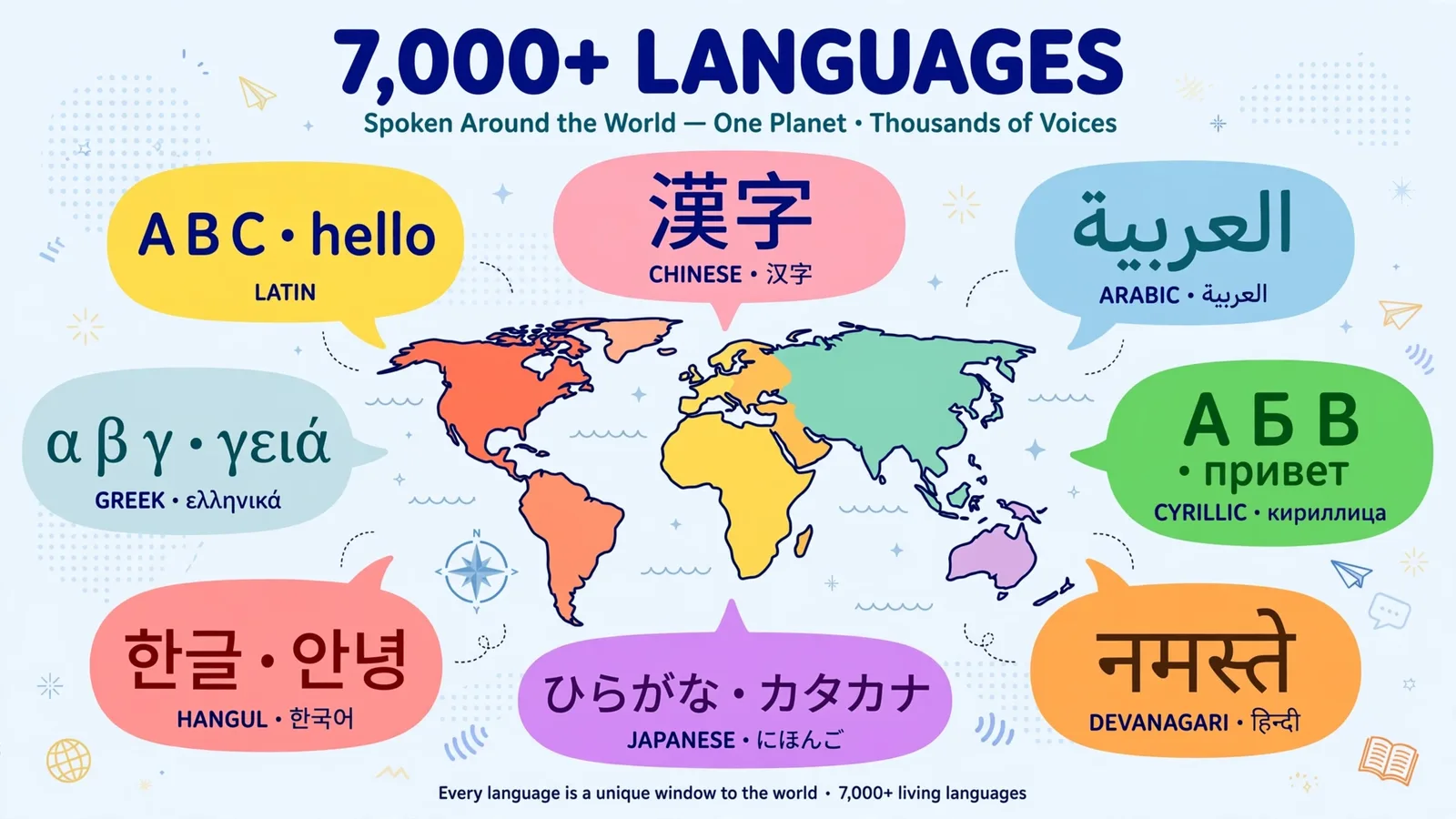
Here’s a question that sounds simple and isn’t: how many languages does the world speak? You might guess a few hundred. The real answer is so much bigger — and so much sadder — than most people imagine. Around 7,000 languages are spoken on Earth right now. And we’re losing them at a rate that linguists describe, without exaggeration, as a mass extinction.
This is the story of humanity’s most diverse invention, how it got so lopsided, and why the disappearance of a language is a bigger deal than it sounds.

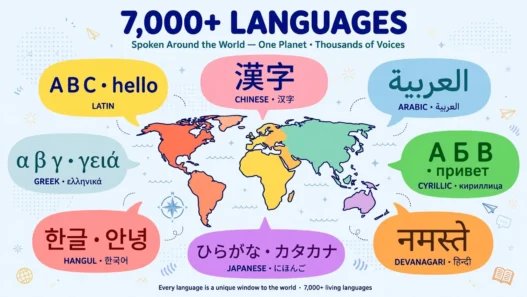
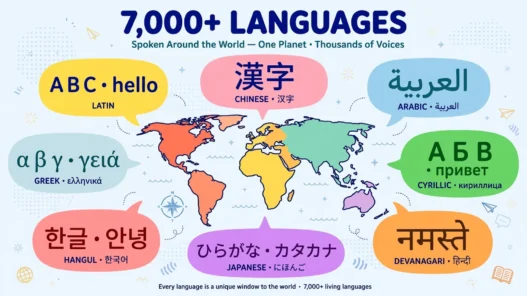
7,000 languages — and half the world speaks just 23 of them
The best current count comes from Ethnologue, the most comprehensive catalog of the world’s languages, which lists around 7,160 living languages. (Counts vary — some catalogs go higher — because deciding where a “dialect” ends and a “language” begins is genuinely tricky. Is Cantonese a language or a dialect of Chinese? Linguists have strong opinions and no referee.)
But here’s the staggering part: just 23 languages are spoken by more than half of all humans. English, Mandarin, Spanish, Hindi, Arabic, French — the big global languages Hoover up speakers while thousands of smaller languages survive in single valleys, single villages, sometimes single families.
The numbers at the top are enormous. Mandarin Chinese has around 940 million native speakers. Spanish has roughly 485 million. English has about 380 million native speakers — but when you count second-language speakers, English explodes to 1.5 billion people, making it the world’s most-spoken language overall and the closest thing humanity has to a common tongue.
The most linguistically diverse place on Earth
If you want to see language diversity at full blast, go to Papua New Guinea. This one country — smaller than California, with about 10 million people — is home to roughly 840 living languages. That’s more than 10% of the world’s total, in 0.5% of its land area.
Why? Mountains and valleys. For thousands of years, rugged terrain kept communities isolated enough that their speech drifted apart, generation after generation, until neighbors a few ridges over were mutually unintelligible. It’s a natural experiment in how languages are born: isolation plus time equals new languages. The same process, running over millennia, produced the thousands of languages of the Amazon, the Caucasus, and pre-colonial North America.
And the reverse process — contact plus time — is what’s killing them now. Roads, radio, schooling, and migration pull small communities into big languages, and each generation speaks a little less of the ancestral tongue.
A language dies every two weeks
This is the statistic that stops people cold: by the most commonly cited estimate, a language disappears roughly every two weeks. UNESCO classifies more than 40% of the world’s languages as endangered, and linguists warn that between half and 90% of today’s languages could be gone or moribund by the end of this century.
Let’s be honest about what “dies” means here. Languages don’t usually vanish in a dramatic final moment. They fade: grandparents speak it fluently, parents understand it but answer in the dominant language, children know a few words — songs, food names, jokes. Then one day there are no fluent speakers left, and a way of describing the world goes quiet.
The most fragile languages are the ones you’ve never heard of: languages with a few hundred speakers, no written form, and no presence online. Of the 7,000+ languages in the world, fewer than 100 have any real footprint on the internet. A language that isn’t used in school, in media, or online faces brutal odds with each new generation.
Why it matters: a language is a knowledge archive
“So what?” is a fair question. If everyone ends up speaking a handful of global languages, isn’t that just… efficient? Here’s what that view misses: languages encode knowledge that doesn’t exist anywhere else.
Indigenous languages routinely contain sophisticated ecological knowledge — which plants heal, when fish spawn, how weather patterns shift — accumulated over centuries of observation. When the language dies, that knowledge often dies with it, because it was never written down anywhere else. Linguists have documented medicinal plant knowledge, navigational systems, and agricultural techniques that exist only in endangered languages.
Languages also carve up reality differently in ways that genuinely affect thought. Some languages have no words for left and right, using cardinal directions instead — and their speakers navigate with an almost supernatural sense of direction. Some languages treat time as flowing uphill. Whether language shapes thought or merely reflects it is still debated, but every lost language is a lost experiment in how minds can work. It’s not just words disappearing; it’s possibilities.
The fightback: languages coming back from the brink
The story isn’t all elegy. Language revival is real, and some of it is spectacular. Hebrew went from a liturgical language with no native speakers to the mother tongue of millions — the only fully successful revival of its kind. Welsh declined for a century, then stabilized through bilingual schooling; about a third of Wales now speaks it. Māori in New Zealand and Hawaiian in Hawaii were pulled back through “language nest” preschools where children are immersed from infancy.
Technology is helping, too. Apps, YouTube channels, and online dictionaries let diaspora communities learn ancestral languages from thousands of miles away — and as our guide to learning a language online shows, digital tools have quietly become one of the most powerful forces in language learning of any kind. Community activists record elders, build talking dictionaries, and teach on TikTok. A language with a thousand speakers and a smartphone can now reach further than a language with a million speakers could fifty years ago.

What you can actually do
You don’t need to become a field linguist to matter here — though the world could use more of them. Small things count: if your family speaks a heritage language, use it with the kids in your life; intergenerational transmission is the single biggest predictor of survival. Learn a few phrases of an endangered language spoken near you. Support the archives and apps documenting them.
And there’s a selfish reason to care: learning any second language — even a giant global one — plugs you into the cognitive benefits researchers keep finding, from sharper attention to delayed cognitive aging. As one learner discovered, learning English online opened doors they’d never imagined — professional, cultural, and personal. Multiply that by 7,000, and you start to grasp what’s at stake every two weeks.
Seven thousand ways to say “I love you,” “I’m hungry,” “look at that sky.” However many survive the century, each one carries a version of the world that no other language quite captures. That’s worth knowing — and worth keeping.