








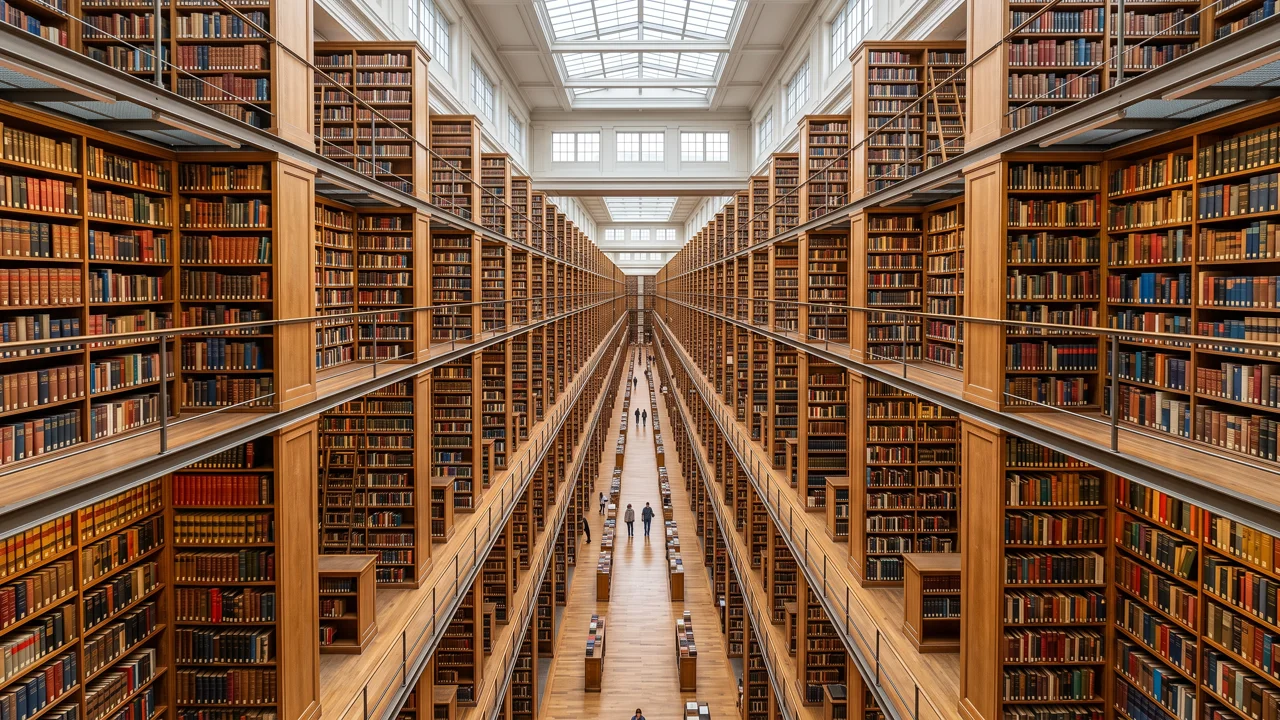
Imagine a building that adds thousands of new items every single working day. Imagine shelves that, laid end to end, would stretch from one city to another. The world’s biggest libraries aren’t just big — they operate at a scale that breaks your intuition. Let’s tour them in numbers.

Library of Congress: the heavyweight champion
The Library of Congress in Washington, D.C. is the largest library in the world by most measures, holding more than 170 million items — books, manuscripts, maps, photographs, films, and recordings. Its shelves run for roughly 1,350 kilometers (838 miles) — laid straight, they’d stretch from Paris to Rome. Every working day, it acquires around 10,000 new items. The main reading room alone, with its iconic domed ceiling, seats hundreds of researchers beneath 15 meters of neoclassical grandeur. It was founded in 1800, burned by the British in 1814, rebuilt by Thomas Jefferson’s personal library, and never stopped growing since.
British Library: the quiet co-champion
London’s British Library holds a similarly mind-bending 170+ million items, and by some counts it edges ahead — the two institutions trade the “world’s largest” title depending on how you count. Its treasures include two of the four surviving original copies of the Magna Carta, Leonardo da Vinci’s notebooks, and the earliest dated printed book in existence. Every book published in the UK and Ireland arrives here by legal deposit — around 8,000 new items every day — which means the collection grows whether anyone curates it or not. Somewhere in its 625 kilometers of shelving, there’s a copy of almost everything ever printed in Britain.
The rest of the giants
The top tier is a two-horse race, but the next ranks are impressive in their own right:
- New York Public Library — around 55 million items across its research and branch libraries, serving millions of visitors a year. Those famous stone lions out front guard one of the world’s great public collections.
- Library and Archives Canada — roughly 54 million items, preserving everything from government records to the portrait of the country’s literary soul.
- Russian State Library (Moscow) — around 47 million items in 300+ languages, one of the great survivors of the 20th century’s upheavals.
- National Library of China (Beijing) — more than 40 million items, including ancient oracle bones and the largest collection of Chinese literature on Earth.
- National Diet Library (Tokyo) — over 40 million items, growing by legal deposit from Japan’s formidable publishing industry.
Numbers that don’t fit in your head
A few more figures to break your brain:
- If you read one item per day from the Library of Congress, you’d need more than 460,000 years to finish — and by then it would have added billions more.
- The British Library adds the equivalent of a small library’s entire collection every few days.
- Some national libraries receive new material faster than any human team could ever catalog it — the backlog is a permanent feature, not a bug.
- The world’s libraries collectively hold billions of items, yet digitization has covered only a fraction. Most of humanity’s written heritage still exists in exactly one physical copy, in exactly one building.
- The Library of Congress’s collections include the largest rare-book collection in North America, more than a million newspapers, and the personal libraries of several US presidents — history, shelved.
The digital giants: libraries without walls
Physical collections tell only half the story now. The Internet Archive has digitized millions of books and hosts billions of web pages, operating at a scale no physical building could match. Google Books has scanned tens of millions of volumes in partnership with major libraries. Project Gutenberg, the granddaddy of them all, offers 70,000+ free e-books and has been doing it since 1971 — before most people had heard of the internet.
These digital collections change what “biggest” even means. A physical library is limited by shelf space; a digital one is limited by copyright law and scanning budgets. The dream — every book ever printed, searchable, accessible to anyone with a connection — is technically closer than ever and legally still distant. The great libraries of the future may not be buildings at all, but the buildings aren’t going anywhere: there’s something about walking into a reading room that a search bar will never replace.
Why bigness isn’t the whole story
Here’s the twist: the most important library in your life is probably tiny. The branch library down the street, the university collection tailored to your major, your own carefully curated shelf — these beat the giants where it counts, because a library’s value isn’t in how much it holds, but in how well it connects you to what you need. The Library of Congress is magnificent, but it can’t do what a good librarian with a recommendation can.
That said, the giants remind us of something worth remembering: humanity has been saving its thoughts for millennia, at staggering scale and cost, on the bet that future strangers — you — would want to read them. The least we can do is take them up on it. Start building your own system for keeping what you learn with a second-brain setup, review it properly, and give your books a home worthy of them — even a budget study space can hold a world-class collection.

One hundred seventy million items. A thousand kilometers of shelves. Ten thousand new arrivals a day. The biggest libraries in the world are monuments to a beautiful, irrational human conviction: that what we write matters, that someone will want it later, and that it’s worth keeping — all of it, forever.
And here’s the part the numbers can’t capture: every one of those millions of items was once somebody’s urgent thought, somebody’s life’s work, somebody’s 2 a.m. idea they couldn’t let go of. The great libraries aren’t really buildings full of books. They’re buildings full of people who refused to be forgotten — and the librarians, archivists, and catalogers who agreed with them. That’s a legacy worth visiting, even if you only ever see a fraction of it.