







In 2004, Sal Khan was not a teacher. He was a hedge fund analyst in Boston with three degrees from MIT and an MBA from Harvard — the kind of guy whose math skills were being used to make rich people richer. Then his 12-year-old cousin Nadia, stuck on the other side of the country in New Orleans, started struggling with unit conversion. So Sal did what any decent cousin would do: he started tutoring her after work, over the phone, scribbling diagrams on an app called Yahoo Doodle.
It worked. Nadia got into the more advanced math track. Word spread through the family. More cousins wanted in. Soon Sal was juggling tutoring schedules on top of his day job, and it was becoming a mess — so he came up with a hack. He recorded his lessons on video, posted them on YouTube, and told his family to just watch whenever they wanted.
That was 2006. And this is where the story stops being about one family.
Strangers started showing up
Sal had uploaded the videos for maybe a dozen relatives. But YouTube doesn’t care who you meant something for. Within a couple of years, strangers were watching. Thousands of them. Then hundreds of thousands. Comments poured in from people who’d been failed by their schools, adults relearning math at midnight, parents who finally understood fractions for the first time while helping their kids with homework.
The feedback had a theme: people liked that they could pause, rewind, and rewatch without anyone judging them. No teacher sighing when you ask the same question twice. Just a disembodied voice and a black digital canvas, explaining things at whatever pace you needed.
By 2008, Sal did something serious: he incorporated Khan Academy as a 501(c)(3) nonprofit. It wasn’t a side project anymore — it was an organization with a mission: free, world-class education for anyone, anywhere. The YouTube channel kept growing on its own momentum, and Sal kept recording after his day job ended.
But there was a problem. Sal was still working at his hedge fund. His wife, in what might be the most supportive move in edtech history, agreed that he should quit his well-paid job to make math videos full time. In the fall of 2009, he did it. He lived off his savings for nine months, working out of a converted closet in his home, cranking out tutorials.
His first meaningful donation came from Ann Doerr. Then the dominoes fell.
The Gates email and the Google check
Bill Gates has said — publicly, multiple times — that he used Khan Academy videos to learn things and to help his own kids. That kind of attention changes everything. In September 2010, Khan Academy landed two grants that turned it from a one-man operation into an actual institution: $2 million from Google and $1.5 million from the Bill & Melinda Gates Foundation.
Sal brought in Shantanu Sinha, an old friend and former MIT math-competition rival, as president and COO. They hired software engineers and designers. In October 2010, the tiny team moved into its first real office. The videos were no longer just videos — the site was becoming a full learning platform with practice exercises, progress tracking, and dashboards for teachers.
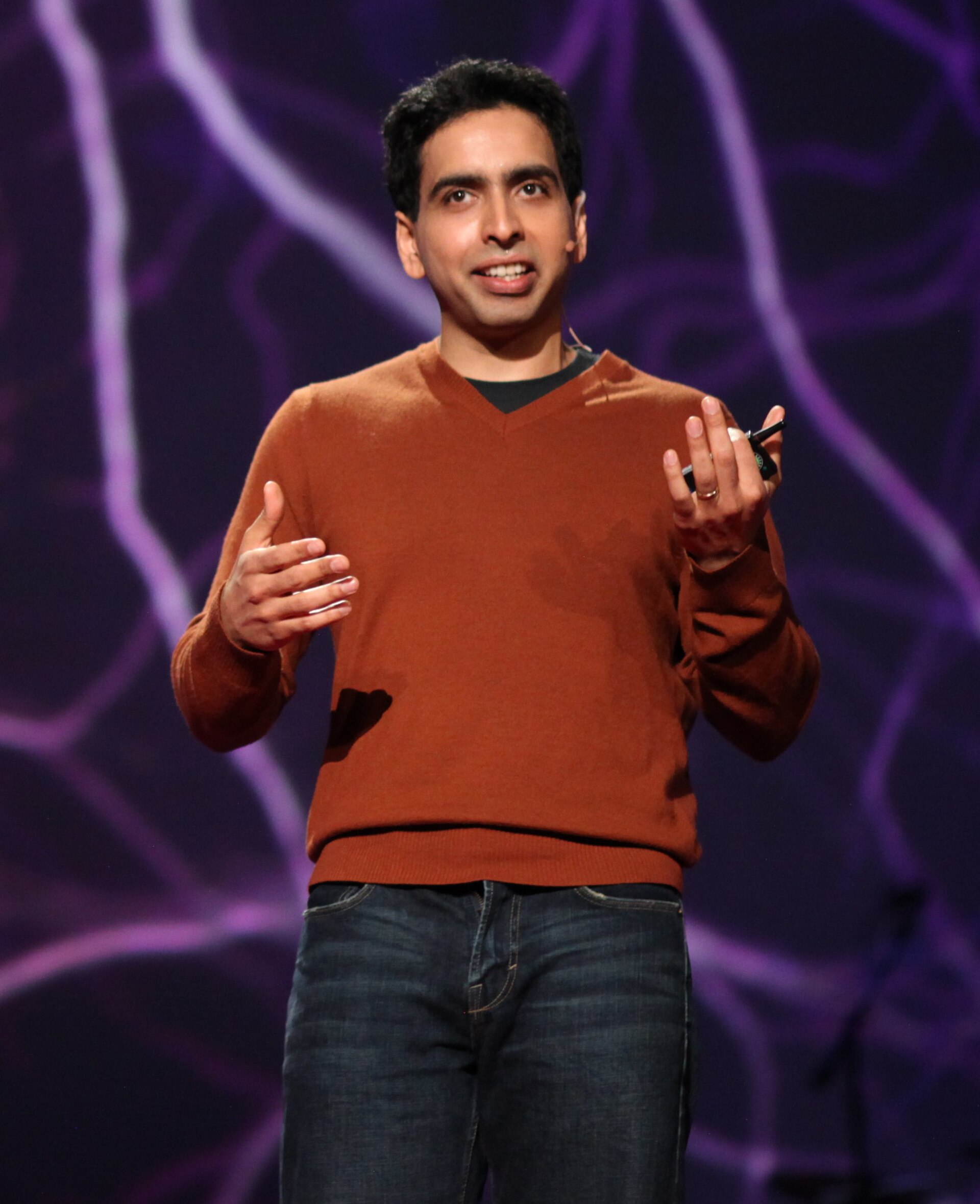
In 2011, Sal gave a TED talk that became one of the most-watched TED talks ever. The core argument: classrooms have it backwards. Students should watch lectures at home and do the hard work — the problem-solving, the questioning, the collaboration — in class, with a teacher right there. The “flipped classroom” idea exploded, and suddenly Khan Academy was the name attached to a whole new philosophy of teaching.
Going to school — literally
Here’s something most people don’t know: Sal Khan didn’t just stay online. In 2014, he founded Khan Lab School, a real brick-and-mortar school in Mountain View, California, designed as a laboratory for the ideas the platform was testing — self-paced learning, mixed-age classrooms, mastery before moving on. The online platform became a testing ground, and the school became a testing ground for the platform.
The nonprofit kept scaling through philanthropy rather than venture capital — a deliberate choice that kept everything free. Carlos Slim’s foundation funded Spanish-language videos. AT&T put in $2.25 million for mobile access. Elon Musk’s foundation donated $5 million in 2021. By the pandemic, the numbers were staggering: traffic surged as schools closed, and the platform was serving tens of millions of learners a month in dozens of languages.
Today Khan Academy offers courses well beyond math — science, computing, history, economics, test prep for the SAT and LSAT — and it’s embedded in classrooms around the world. Teachers assign its videos and exercises as homework. Students in places with no good local schools use it as their school.

Why it actually worked
A lot of edtech startups raised hundreds of millions and flamed out. Khan Academy did the opposite: it stayed small on purpose, stayed nonprofit, and stayed focused on the unsexy stuff — covering every prerequisite, making every video rewatchable, tracking mastery instead of attendance.
The insight was never the technology. The insight was Nadia. One kid, stuck on unit conversion, learning better when she could rewind. Everything Khan Academy became — the grants, the TED talk, the millions of learners — is just that insight scaled up.
If you’re the kind of learner who does best with video, by the way, Khan Academy’s style is basically the gold standard — short, focused, pause-friendly. Just watch out for the rabbit hole: it’s worth reading how to learn from YouTube without getting distracted before your “one quick video” turns into a three-hour binge. And if you’re weighing free resources against paid ones, this breakdown of free courses vs paid courses is a good reality check — Khan Academy proves that free can be genuinely excellent, but it won’t be free in every subject forever.
What started as a cousin’s homework help became one of the most important education projects of the century. Not bad for a guy scribbling on Yahoo Doodle.