

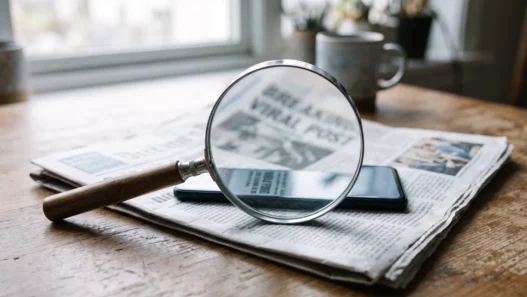





You’ve seen it happen in real time: a shocking headline rockets around your group chat, everyone reacts, and three hours later it turns out the photo was from 2019 and the “study” was a blog post. Nobody shared it to lie — they shared it because it felt true, and feeling true is exactly what misinformation is engineered to do.
Here’s the thing professional fact-checkers know: you don’t need to be an expert to catch most fake news. You need a 30-second routine. Not a research project — a quick set of reflexes that filter out the overwhelming majority of junk before it reaches your brain, let alone your group chat.
Why your brain is the vulnerability
Quick detour into why smart people fall for dumb stories. Psychologists have mapped a few glitches that misinformation exploits:
Confirmation bias: we accept claims that fit what we already believe with almost no scrutiny, and interrogate claims we dislike. A fake story that flatters your worldview gets a free pass.
The illusory truth effect: repeat anything often enough and it starts feeling true — even when you know it’s false. This is why the same debunked claims keep resurfacing: repetition is doing the persuading, not evidence.
Emotional hijacking: outrage, awe, disgust, and fear all suppress critical thinking. Notice how the stories you’re most tempted to share instantly are the ones that made you feel something strong? That’s not a coincidence. It’s the business model.
Knowing these glitches exist doesn’t make you immune — but it does give you a tripwire: the stronger your emotional reaction, the slower you should go. That pause is the entire game.
The 30-second check: four questions
Memorize these. Run them on anything surprising before you believe it or share it.
1. Who’s telling me this? (10 seconds)
Look past the headline to the source. Is it a news organization you’ve heard of, with named journalists and an corrections policy? Or is it a site you’ve never seen, with no “About” page, no author names, and a domain like realtruthnews247.biz? Check the URL carefully — impostor sites mimic real outlets with tiny tweaks (cnn-today.com is not CNN). If you can’t figure out who’s behind a site in ten seconds, that’s your answer.
2. What’s the evidence — actually? (10 seconds)
Real reporting shows its work: named sources, documents, data you could check. Fake stories lean on “sources say,” “a friend of a friend,” screenshots of text, or no evidence at all — just confident assertions. Be especially wary of screenshots presented as proof: a screenshot of a headline is not the article, and a screenshot of a tweet is not the tweet. Both are trivially faked. And if a post claims “the media won’t report this,” ask yourself why the world’s most competitive industry would collectively ignore a real scoop.
3. Is this current? (5 seconds)
A huge share of viral misinformation is real content with a false date: genuine photos and videos from old events, recycled as if they happened today. Check the timestamp. Then check whether the images are recycled — right-click (or long-press) and reverse-image-search them. If that dramatic photo of a protest is from a different country three years ago, you’ve caught it in five seconds flat.
4. Who else is reporting it? (5 seconds)
This is the fact-checker’s secret weapon, and it has a name: lateral reading. Instead of reading deeper into the suspicious site, open a new tab and search the claim. If multiple independent, reputable outlets report it, it’s probably real. If only the original site and its copycats have it — or if the only “coverage” is debunking articles — walk away. Thirty seconds, one search, enormous clarity.
Red flags that deserve instant suspicion
Some patterns are so reliably shady that they should trigger your tripwire on sight:
- ALL CAPS outrage headlines with excessive punctuation. Real newsrooms don’t write like that.
- “Share before they delete this!!!” — the classic manipulation: manufacturing urgency to bypass your critical thinking. (See: emotional hijacking, above.)
- Miracle cures, secret suppressions, and “one weird trick.” If it sounds too good — or too conspiratorial — to be true, apply question 4 immediately.
- Perfectly emotional photos. The more a single image seems designed to make you feel rather than understand, the more likely it’s miscaptioned, staged, or AI-generated.
- No author, no date, no sources. Anonymity isn’t proof of falsehood, but accountability is a strong signal of truth.
What to do when you’ve already shared something false
It’ll happen. Everyone with a phone has amplified something dodgy at least once. What matters is the correction, and research on this is encouraging: corrections work better than most people assume, especially when they come from someone the audience trusts — like you, in your group chat.
Don’t just delete silently. Post the correction where you posted the claim, keep it brief and non-preachy (“Update: this turned out to be from 2019, not today — my bad”), and link the debunking source. The goal isn’t public self-flagellation; it’s making sure the false version doesn’t keep traveling without its correction attached. People respect the update far more than they judge the mistake.
And resist the urge to argue with committed believers in comment sections. Studies of persuasion suggest that direct confrontation often hardens false beliefs (the backfire effect is debated, but “you’re an idiot, here’s a link” has never changed a mind in recorded history). Share the evidence once, clearly, then move on.

Build the reflex: make verification a habit
The 30-second check works best when it’s automatic — like looking both ways before crossing. A few ways to install it:
Slow your share finger. Make it a personal rule: surprising claims sit for one search before they get forwarded. Most misinformation dies at this step, because most of it can’t survive a single lateral read.
Diversify your information diet. If every source you read agrees with you on everything, you’re not informed — you’re comfortable. Following a few high-quality outlets with different perspectives makes anomalies (and fabrications) stand out faster. Learning to ask good questions — of your courses, your sources, your own assumptions — is the same muscle.
Teach someone. Show a parent or younger sibling the reverse-image-search trick. Explaining the 30-second check out loud cements it in your own reflexes — and misinformation preys hardest on people nobody taught.
The internet will keep generating 230 million emails and 6 million searches a minute, and a fraction of all that will be designed to mislead you. You can’t fact-check the ocean. But you don’t need to — you just need 30 seconds, four questions, and the discipline to pause when something makes you feel more than it makes you think. That’s not cynicism. It’s literacy for the world we actually live in. And if you want to understand more of the mental shortcuts that shape what you believe, the real story behind popular learning myths is a good next read on how easily intuition misleads us.